
1 / 10

Vigilante Parts
2 / 10

Dynamic
3 / 10

Pacific
4 / 10

Madcap
5 / 10

Bigtime Automotive
6 / 10

DHR Motorsports
7 / 10

Probe
8 / 10

ATD
9 / 10

Jesel
10 / 10

Precision

You are using an out of date browser. It may not display this or other websites correctly.
You should upgrade or use an alternative browser.
You should upgrade or use an alternative browser.
Foxy Green Foxbody Build
- Thread starter 89 Fox 427
- Start date

89 Fox 427
Slower than promised
- Joined
- Jan 22, 2021
- Messages
- 15,267
- Reaction score
- 30,665
- Points
- 153
34 total with the current bushing. Will likely buy a 14 degree bushing so I can have 18 initial 32 totalIf you use manifold vacuum (likely best?), then at full throttle, when you have little to none manifold vacuum, you will only have 26 degrees total?

Steve439
Platinum Member
If you use manifold vacuum (likely best?), then at full throttle, when you have little to none manifold vacuum, you will only have 26 degrees total?
That would happen with ported vacuum too, the ported and full sources are the same once the throttle blades are open.
You get it, so will fox understand?That would happen with ported vacuum too, the ported and full sources are the same once the throttle blades are open.
Vacuum source timing, won't add to the total at WOT.
89 Fox 427
Slower than promised
- Joined
- Jan 22, 2021
- Messages
- 15,267
- Reaction score
- 30,665
- Points
- 153
I don't know what makes you think I don't get it but ok
kilowattkid
Aluminum Member
- Joined
- Aug 15, 2021
- Messages
- 1,183
- Reaction score
- 2,956
- Points
- 113
I think 18/32 is a safe conservative start.
This link is to a thread about modifying Delco and MSD distributor weights

 www.tapatalk.com
You need to put something like that 3/16" stainless tubing (nitrous line) or a drill bit or 3/16" steel rod through the pivot hole to keep it from distorting.


I have a propane torch that is hot enough to get the weights to bright orange near yellow heat where they bend easily. When the steel is the right temperature it bends easily.
Be aware some new distributor weights I have encountered in the last couple of years, zhynah counterfeits and ?, are sintered metal, compressed powdered metal like an old Chevy crank sprocket, not solid steel, so they can not be heated to bend, they crumble and break.
racingfuelsystems-MSD-Delco Distributor Weight Modification For Less Advance
Using a big bushing to limit travel in an MSD stops the travel of the weight lever arm at a location on the advance cam further from the distributor s
www.tapatalk.com
You need to put something like that 3/16" stainless tubing (nitrous line) or a drill bit or 3/16" steel rod through the pivot hole to keep it from distorting.
I have a propane torch that is hot enough to get the weights to bright orange near yellow heat where they bend easily. When the steel is the right temperature it bends easily.
Be aware some new distributor weights I have encountered in the last couple of years, zhynah counterfeits and ?, are sintered metal, compressed powdered metal like an old Chevy crank sprocket, not solid steel, so they can not be heated to bend, they crumble and break.
The mechanical curve is WOT RPM related timing. There is no (or very little) vacuum at WOT, unless the carb is too small, such as restricted circle track with a 350 or 500 2bbl or 390 4bbl.What a pile of questions i have..
What does a distributor machine do?
Trying to wrap my brain around your whole message, you'd like to see 12 degrees advance at 16"hg vacuum. Based on my spring/bushing combo on the turd I have (all in 34* by 3000) it would roughly equate to:
At 2000 rpm cruise with 20" vacuum
16 initial
10 centrifugal
10 vacuum (the max my canister will advance)
Putting me at 36 degrees, but you mentioned a 393 you messed with wanted 22 at 2000.
Am I screwing up the interpretation?
To understand the vacuum advance, you guys need to connect a vacuum gauge to manifold vacuum and see what the vacuum does, how it varies at different RPMs when you change throttle positions, cruise, light and heavy acceleration.
This was the PM post you refer to above ^ the RPM related advance is describing the mechanical advance, the vacuum is .... the vacuum advance.
"The last 393 Ford I did wanted
18 initial, start 1200 RPM,
22 at 2000,
24 at 3000,
26 at 4500 and
28 at 6000 <--(edit-- that originally, in the PM, was 5000)
Vacuum advance 0 deg 8" Hg, start or 1 deg 9" Hg and total 12 deg 16" Hg."
The ^^ advance numbers are in crankshaft degrees.
In the case of that particular engine it was a situation of the 393 Windsor had some generic chinese aluminum head, copy of ?, that were on it because the price was right, and the chamber size was intended for a 5.0L 302 I think, and because the cam timing was conservative it had too much compression for pump gas and knocked like a bitch with the "all in at 2500" MSD distributor with the black bushing 18 degree curve.
... so ... we formed a committee of three of us, one young enough to have good ears, and went cruising around one night with a timing light messing the distributor back and forth while making short 1000 RPM "pulls" in every RPM range from idle to valve float, the purpose was to find the amount of advance which ran OK and did not knock.
It was fun, we spent two or three hours in the middle of the night giggling like it was 1966 again (engine was in a 1966 Mustang). We took notes and decided on how much timing at each point in the RPM range from idle to 6000 or so was the hot setup, then I used the distributor machine to setup a Ford Motorcraft distributor and added the vacuum advance. Ford vacuum chambers are adjustable and I think we fiddled with it after installing that distributor and driving the car some more while tuning the carb.
For a highway car you need to finalize the ignition advance scheme before tuning the carb.
I don't/didn't think you don't.I don't know what makes you think I don't get it but ok
Acknowledgement clears the conversation.
Help me out, so I understand your total.
Cruise vs WOT.
89 Fox 427
Slower than promised
- Joined
- Jan 22, 2021
- Messages
- 15,267
- Reaction score
- 30,665
- Points
- 153
I don't/didn't think you don't.
Acknowledgement clears the conversation.
Help me out, so I understand your total.
Cruise vs WOT.
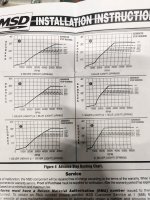
I don't know the cruise timing, rpm dependent obviously. Vacuum is plugged, so all I can go off is these graphs from msd. 18 degree bushing (black) with 16 degree initial right now, 34 total. I can change springs to any suggestions here.
kilowattkid
Aluminum Member
- Joined
- Aug 15, 2021
- Messages
- 1,183
- Reaction score
- 2,956
- Points
- 113
2 blue to start out. Mixing spring rates can give premature wear. Find a vac can.
kilowattkid
Aluminum Member
- Joined
- Aug 15, 2021
- Messages
- 1,183
- Reaction score
- 2,956
- Points
- 113
18/32 all in at 3500, with a can that works at idle on manifold just seems like a nice conservative start that should allow to run good and tweak on it as you learn more. You won't really know for sure where it wants to be until you get more run time, it just sounds like a safe start to me.
89 Fox 427
Slower than promised
- Joined
- Jan 22, 2021
- Messages
- 15,267
- Reaction score
- 30,665
- Points
- 153
I think you mean the 2 silver heavy springs, gets me all in at 350018/32 all in at 3500, with a can that works at idle on manifold just seems like a nice conservative start that should allow to run good and tweak on it as you learn more. You won't really know for sure where it wants to be until you get more run time, it just sounds like a safe start to me.
The 2 blue is 2500.
Also I'll have to try once I get bushings but I think the engine would crank with initial at 20. Because at 18 it didn't sound like it was struggling at all.
All that shit being said, pretty sure once I find what total it likes, initial doesn't mean fuck all, it is what it is
kilowattkid
Aluminum Member
- Joined
- Aug 15, 2021
- Messages
- 1,183
- Reaction score
- 2,956
- Points
- 113
You're right, 2 silver, I was looking at the wrong line. 18/32 gives you a little room to go 20/34. It may like 36, won't know until you really get more drive time, but 18/32 seems like a safe starting point.

BOSS#1540
Silver Member
What's yer duration @ .050 and your CR ?I think you mean the 2 silver heavy springs, gets me all in at 3500
The 2 blue is 2500.
Also I'll have to try once I get bushings but I think the engine would crank with initial at 20. Because at 18 it didn't sound like it was struggling at all.
All that shit being said, pretty sure once I find what total it likes, initial doesn't mean fuck all, it is what it is
Mine wanted 20°+ to start, and starts great with 31° when hot or cold
89 Fox 427
Slower than promised
- Joined
- Jan 22, 2021
- Messages
- 15,267
- Reaction score
- 30,665
- Points
- 153
In my recent searches I've not seen a ford with fast burn want 36. Most have been between 30 and 32. Doesn't mean mine falls in that category, track time will give me that answer!You're right, 2 silver, I was looking at the wrong line. 18/32 gives you a little room to go 20/34. It may like 36, won't know until you really get more drive time, but 18/32 seems like a safe starting point.
89 Fox 427
Slower than promised
- Joined
- Jan 22, 2021
- Messages
- 15,267
- Reaction score
- 30,665
- Points
- 153
What's yer duration @ .050 and your CR ?
Mine wanted 20°+ to start, and starts great with 31° when hot or cold
243/255 10.4:1. Mine starts at 14,16, 18* so far no issue but haven't tested starting it hot. 140* was the warmest water temp has been on restart. Hasn't gotten over 175 degrees yet while running but it's a balmy 45 degrees when I've had it out
Steve439
Platinum Member
In my recent searches I've not seen a ford with fast burn want 36. Most have been between 30 and 32. Doesn't mean mine falls in that category, track time will give me that answer!
At this point I think itey has the right idea about a phone app.
I'm sure that's what I'll use.
Find the right stretch of road and you can do dozens of tests for free.
89 Fox 427
Slower than promised
- Joined
- Jan 22, 2021
- Messages
- 15,267
- Reaction score
- 30,665
- Points
- 153
At this point I think itey has the right idea about a phone app.
I'm sure that's what I'll use.
Find the right stretch of road and you can do dozens of tests for free.
Maybe, but not likely with this turd. And what I mean by that is this car will likely just break tires loose during the tests and make counting seconds between 1000 rpm stretches inaccurate.
The deal with timing is ..... too much advance can hurt an engine with detonation and not enough will only reduce the power, and probably not much.
If the fuel octane is high enough it can't knock no matter how much advance is used, most engines will lose more power with a couple degrees too much advance than several degrees retarded from best power at whatever RPM it is being measured.
You need to find the least advance which makes best power, so it is a no-brainer to start out conservative and for the first adjustment in testing, always retard timing because that is safer for the engine, and don't be surprised if you get more power, these new cylinder head designs need much less timing than most people think who haven't been tuning engines using them.
The problem of too much advance is compounded by people dynoing engines using too low water and oil temperature, below the actual operating temperature in the car. This will always want more advance than a full up to operating temp engine.
A drag race deal with the garden hose between rounds might run that cold, but a dyno with a cooling tower will always cause the engine to want too much timing for the highway, oval track or road racing.