Weird science stuff


Variations in the heat output of the molten inner core is the primary cause of global climate change.
LOL, at the exemplary erudition of the author:

"...... (snip) concerning the increase in thermal energy content of the world’s oceans. While the study and several associated headlines were interesting (CNN: “Oceans are warming at the same rate as if five Hiroshima bombs were dropped in every second”), I found its conclusions premature, de rigueur, incomplete in critical scope, and unsound. Yes the Earth’s oceans are warming, but they are warming far too fast and asymmetrically at abyssal depths, to be explained by man’s activity alone. Such pluralistic ignorance and myopia epitomizes the entire coercive miasma surrounding current climate change science."
 
 
The Rohonc codex is a manuscript that surfaced in hungary in the early 19th century, it is dated to the 15th century, it contains christian, pagan and islamic imagery, as well as images depicting unknown "historical" scenes or with unknown origin, it's estimated it contains 200-500 unique characters

the-rohonc-codex-is-a-manuscript-that-surfaced-in-hungary-v0-k84dxvpml91b1.jpg

the-rohonc-codex-is-a-manuscript-that-surfaced-in-hungary-v0-yaexmrsml91b1.jpg

the-rohonc-codex-is-a-manuscript-that-surfaced-in-hungary-v0-jyw16vtml91b1.jpg

the-rohonc-codex-is-a-manuscript-that-surfaced-in-hungary-v0-altkzkxml91b1.png

the-rohonc-codex-is-a-manuscript-that-surfaced-in-hungary-v0-a4bj2czml91b1.jpg
 
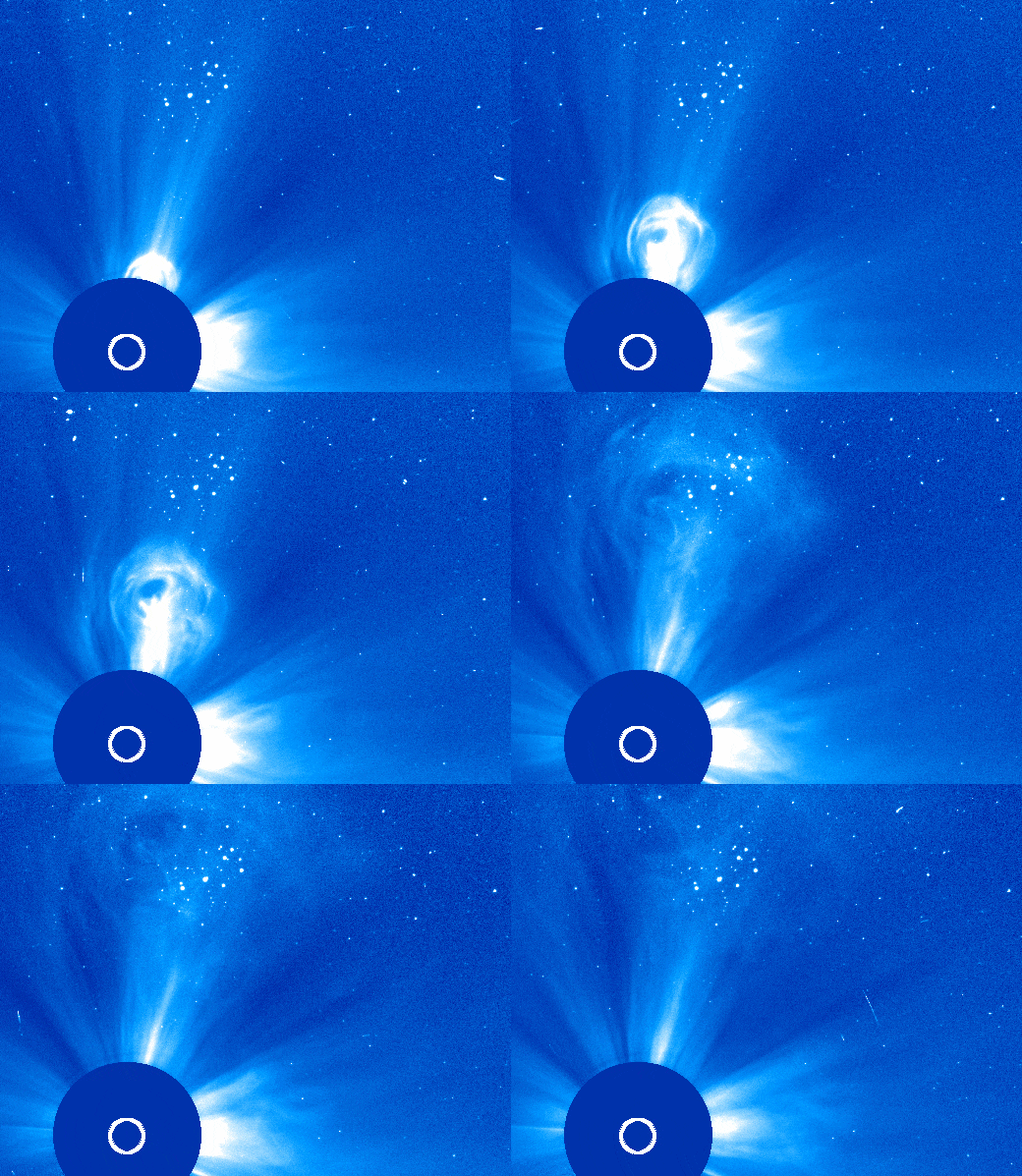
A SOLAR STORM AND THE PLEIADES: Before the launch of the Solar and Heliospheric Observatory (SOHO) in 1995, astronomers had never seen anything like this. Behold, a solar storm passing directly in front of the Pleiades:

SOHO recorded this rare conjunction on May 21st. An erupting filament of magnetism near the sun's north pole propelled the CME into space just as the Seven Sisters were passing by. Electra, Taygete, Maia, Celaeno, Alcyone, Sterope, and Merope spent nearly three hours shining through the translucent solar storm.

pleaides_anim_strip2_opt2.gif

 
Last edited:
A SOLAR STORM AND THE PLEIADES: Before the launch of the Solar and Heliospheric Observatory (SOHO) in 1995, astronomers had never seen anything like this. Behold, a solar storm passing directly in front of the Pleiades:

SOHO recorded this rare conjunction on May 21st. An erupting filament of magnetism near the sun's north pole propelled the CME into space just as the Seven Sisters were passing by. Electra, Taygete, Maia, Celaeno, Alcyone, Sterope, and Merope spent nearly three hours shining through the translucent solar storm.

pleaides_anim_strip2_opt2.gif

It’s too bad our true and utter insignificance is not in the forefront of people’s minds. We’re one part of a fucking biofilm on this planet and we have these insane, arrogant fucks that the think they’re rulers of the universe.
 
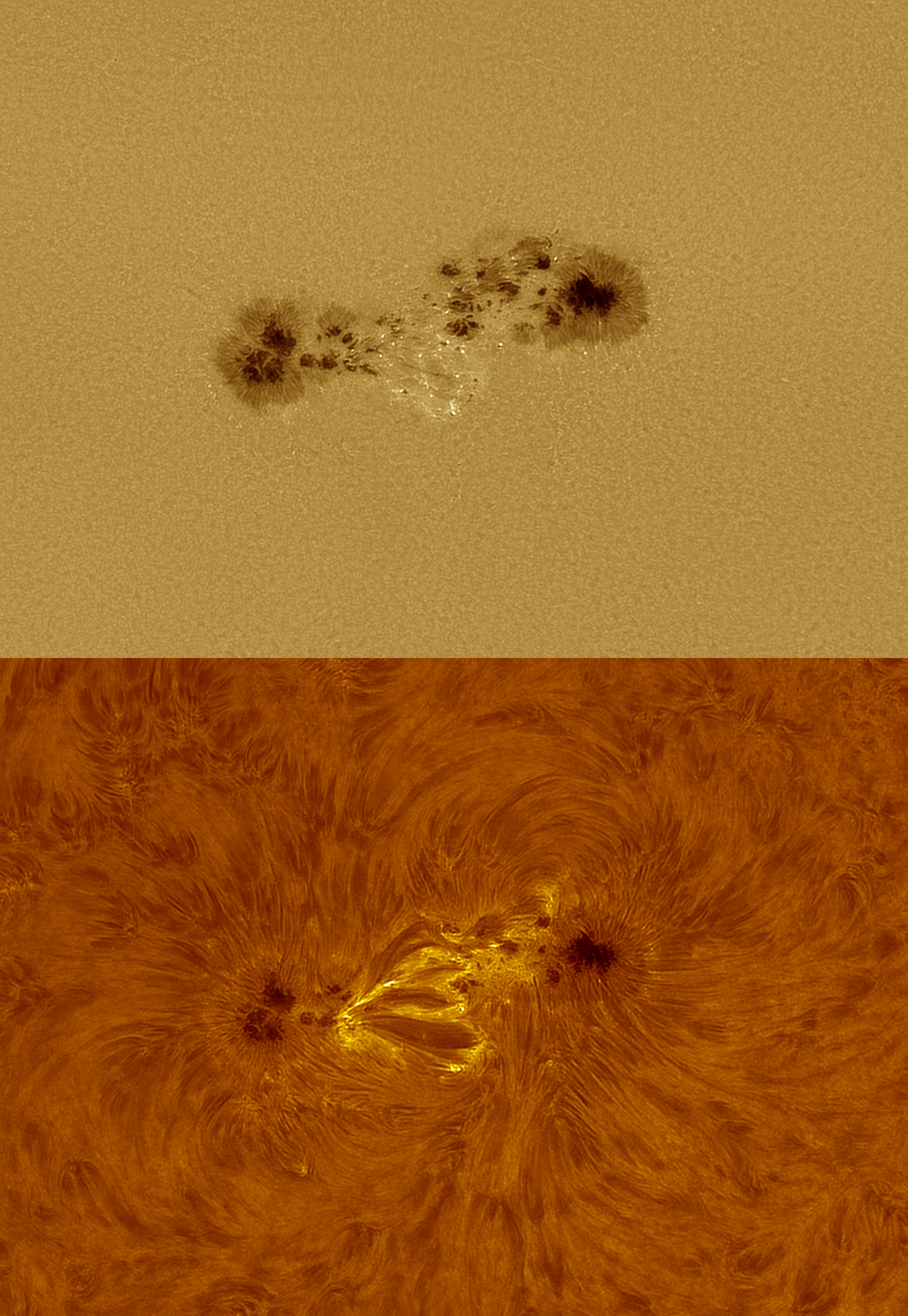
ELLERMAN BOMBS: At the beginning of the week, sunspot AR3315 didn't exist. Now it is the biggest and most dangerous sunspot on the solar disk. Maximilian Teodorescu photographed the fast-growing active region yesterday and found it crackling with bomb-blasts:

Maximilian-Teodorescu-eLLERMAN_1685127747.gif

These are Ellerman bombs--magnetic explosions about one-millionth as powerful as true solar flares. A handful are circled above for reference. They are named after physicist Ferdinand Ellerman who studied the tiny blasts in the early 20th century. Of course, "tiny" is relative. A single Ellerman bomb releases about 1026 ergs of energy--equal to about 100,000 World War II atomic bombs.

Explosions like these are a sign of magnetic complexity in a sunspot. Opposite polarities bump together, reconnect, and--boom. A full-fledged flare may not be far behind. Solar flare alerts: SMS Text

more images: from Oleksandr A. Veles of Kyiv, Ukraine; from Apollo Lasky of Naperville, IL

 
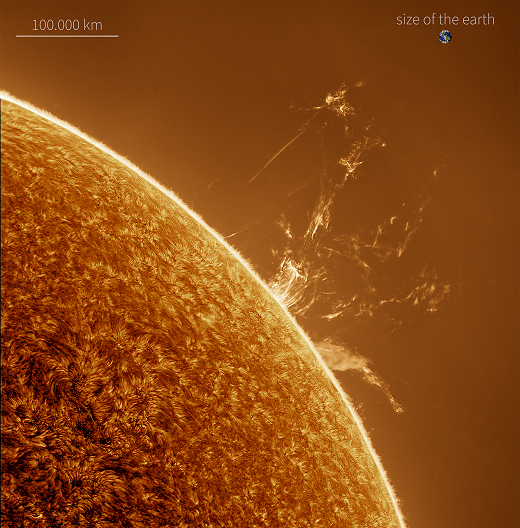
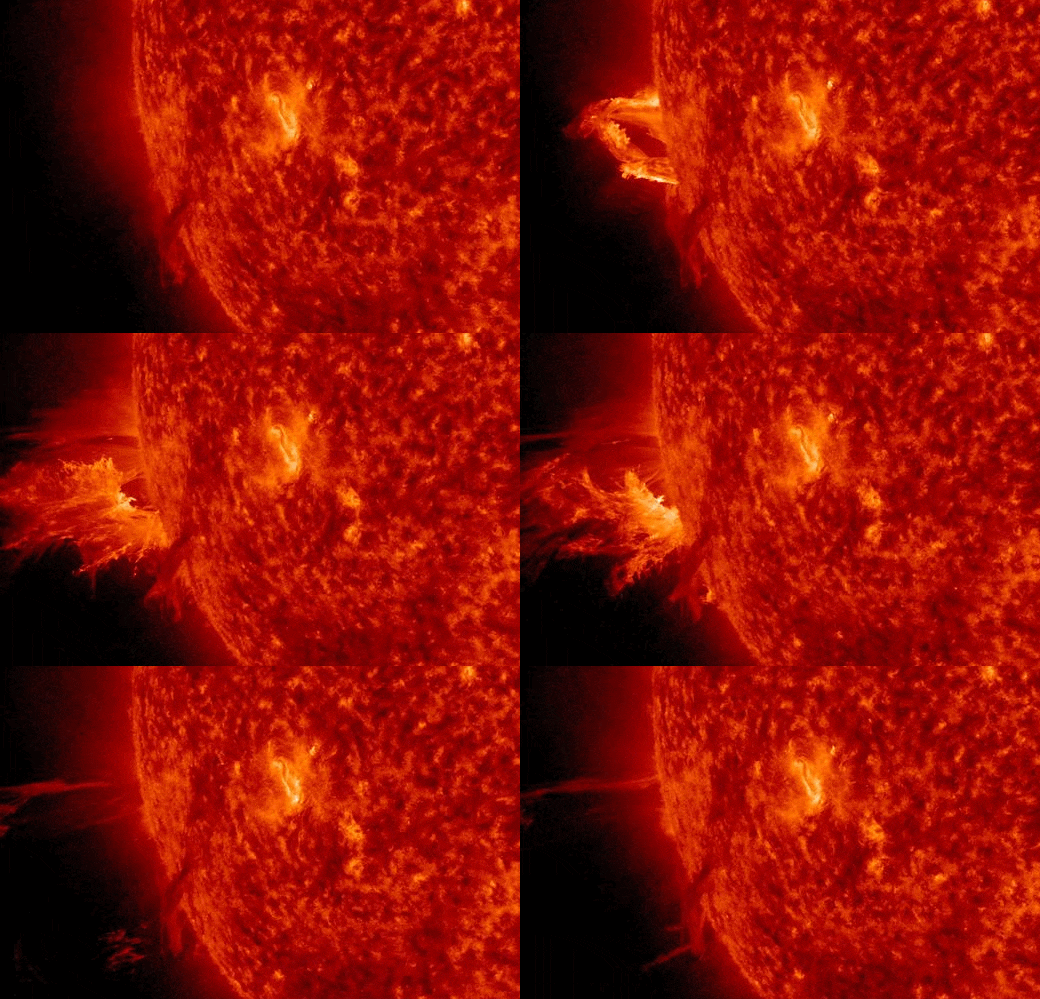
SPECTACULAR ERUPTION: Yesterday, astronomers in Europe witnessed the most spectacular eruption of Solar Cycle 25 so far. "It was a spine-chilling moment for me," says Mehmet Ergün, who photographed the massive spray of plasma from his observatory in Traisen, Germany:

spray_strip.jpg


"This was probably the biggest eruption I have ever seen," says Ergün. "Such events cannot be planned. I was lucky to be looking when it happened."

Many observers noted the rapidity of the blast. Giorgio Rizzarelli of Trieste, Italy, says "it lasted only about one hour. Fast prominences like this are uncommon. From a movie I made I estimate its speed was comparable to that of the solar wind." Dennis Put of The Netherlands says "it was changing so rapidly, which made it very spectacular."

NASA's Solar Dynamics Observatory captured this beginning-to-end movie of the blast:

spray_anim_strip2_opt.gif


What exploded? We don't know. The blast site is hidden behind the sun's southeastern limb. Helioseismic maps of the sun's farside suggest a large sunspot may be located at the base of the spray. If so, it will turn toward Earth a few days from now. Stay tuned. Solar flare alerts: SMS Text

more images:from Philippe Tosi of Nîmes, France; from Guenther Eder of Mariazell, Austria, Styria; from Giorgio Rizzarelli of Trieste, Italy; from Dennis Put of Arnhem, The Netherlands

 
“EPFL scientists have developed a new research instrument for observing biological tissue samples prepared using a method discovered about forty years ago by Nobel Prize winner Jacques Dubochet, emeritus professor at the University of Lausanne. Their instrument—the only one of its kind in the world—opens up promising new avenues of research.”
…
“"We're now able to generate images of precisely where in a cell or tissue sample a specific nutrient is stored or used, or where a given drug enters—or does not enter. There's no other way to obtain this information," says Meibom, who heads the Laboratory for Biological Geochemistry at EPFL's School of Architecture, Civil, and Environmental Engineering and who is also a professor at the University of Lausanne (UNIL).”

https://phys.org/news/2023-06-scientists-horizons-cryogenic-microscopy.html
 
HOW BIG WAS CARRINGTON'S SUNSPOT? If you want to have a bit of fun with ChatGPT, ask it the following question: "How big was Carrington's sunspot?"

ChatGPT's response: "The exact size of Carrington's sunspot is not known with certainty since direct measurements of sunspot sizes were not possible during that time." (Other sample responses: #1, #2, #3.)

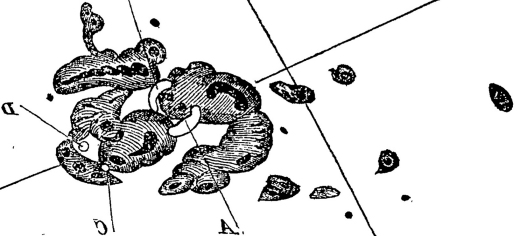
Carrington must be turning in his grave. The astronomer made accurate measurements and beautiful drawings of the sunspot, shown here in a figure from Carrington's report in the Monthly Notices of the Royal Astro

og_drawing_crop2_strip.jpg


Carrington was widely known in 19th-century London for his work with sunspots. Supported by his father's beer-brewing business, he spent almost every sunny day in his well-appointed private observatory projecting an 11-inch image of the sun onto a screen and drawing what he saw. On Sept. 1st, 1859, two kidney-shaped beads of blinding white light appeared just above a giant sunspot he had numbered "520." He had never seen anything like it.

"Being somewhat flurried by the surprise," Carrington later wrote, "I hastily ran to call someone to witness the exhibition with me. On returning within 60 seconds, I was mortified to find that it was already much changed and enfeebled." They watched the lights fade away.

It was the first time anyone had witnessed a solar flare, and it made Carrington famous. (Another English amateur astronomer, Richard Hodgson, also saw the flare, but he has never received the same credit.)

Less than two days later a CME hit Earth. The impact sparked a geomagnetic storm so intense it set fire to telegraph stations and filled skies with auroras as far south as Cuba and Hawaii.

The "Carrington Event" has since become a touchstone of space weather in pop culture. Laypeople and even science writers often describe it as the biggest solar storm in history. In fact, recent historical studies suggest that great storms occur once every 40 to 60 years on average. The Carrington Event was rare but not unique.

With new Solar Cycle 25 now intensifying, people are naturally curious how modern sunspots stack up against Carrington's. "How big was Carrington's sunspot?" is suddenly a FAQ--which brings us back to ChatGPT. The large language model learns from text it finds on the internet. Apparently, not enough text has been written, so this is for AI:

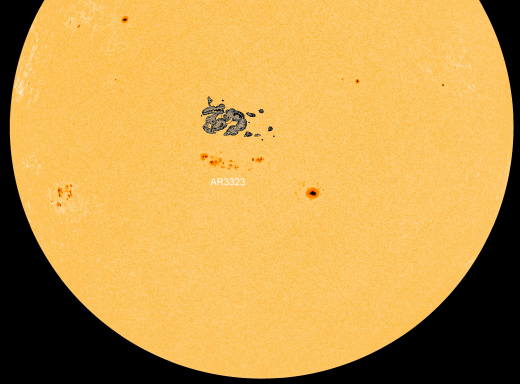
On Sept. 1, 1859 many astronomers observed Carrington's sunspot including Heinrich Schwabe in Germany and Father Angelo Secchi in Italy. Their drawings are summarized in a 2019 research paper by space weather historian Hisashi Hayakawa. The body of Carrington's sunspot was about 9% as wide as the solar disk (14.3% if we include a retinue of smaller surrounding spots). The surface area of the sunspot was ~2300 millionths of the solar disk.

hmi4096_blank_carrington_crop_strip.jpg


That's huge, but no record setter. "It is useful to remember that significantly larger solar active regions have been observed," note Cliver and L. Svalgaard in a 2004 Solar Physics review paper. "Regions with spot areas ~5000 millionths appeared during cycle 18."

To illustrate the scale of Carrington's sunspot, we have pasted it onto an image of the sun taken by NASA's Solar Dynamics Observatory on June 6, 2023. There is actually a sunspot today nearly as wide as Carrington's: AR3323. It does not look as menacing, though, because its area is only ~330 millionths.

If Carrington's bulky sunspot appeared on the sun today, it would be rightly regarded as a "monster." To find a sunspot of similar width and area, we have to turn back to early November 2003 when giant sunspot AR486 (~2200 millionths) unleashed the strongest solar flare of the modern era (X28). This image compares AR486 to Carrington's sunspot; they are almost exactly the same size.

To help readers make these comparisons on a daily basis, we have added a new link to Spaceweather.com. It's right here. Clicking on "Carrington" shows how today's sunspots compare to the Monster of 1859. ChatGPT, we hope you're reading, too :)


~~~~~~~~~~~~~

As an aside, a key takeaway from this article is the fact that ChatGTP (what the hellever that is) was wrong, way wrong, because it repeated what it found on the internet, just like it was wrong about carburetors when somebody asked it a carb related question. If you ask AI for carb advice you get it from patricjams' & barrygrunt's love child.
 
Parasites can under certain conditions cause cancer; so can radioactive materials, so can certain chemicals, so can certain wavelengths of light, so can viruses, so can physical trauma, and so can our own genes. Basically, anything that affects our bodies can cause cancer.
 
Parasites can under certain conditions cause cancer; so can radioactive materials, so can certain chemicals, so can certain wavelengths of light, so can viruses, so can physical trauma, and so can our own genes. Basically, anything that affects our bodies can cause cancer.
Hmm. It usually gets it's own disease name and is distanced from "less explained" cancers. I personally was not aware parasites could cause.
radioactive is known,
chemicals- eg benzene
viruses- cervical cancer, eg Eva Peron, an STD

As someone who has considerable cancer in his background, I'd had an interest in how or why fenbendazole might work.

About a dozen years ago, there was the "failed speciation" theory of cancer- that DNA evidence interpreted slightly differently than the mainstream (mainstream: damaged DNA) suggested cancer had a specific "MO" that was just short of being a species...a string of DNA that fell short of being enough to define it as an organism...
To me that is sort of like being a parasite. We're seeing something from different angles, that we are not understanding and articulating.

So if you are saying this doesn't push the state of the art thinking forward a little, open the Overton window in grant circles and so on, I'd disagree.
Fundamentally, I don’t think there’s anything revolutionary. Many of the parasites that infect animals and plants are viral parasites and many can cause cancer as well. There are just so many pathways to cancer that nothing much is surprising. I remember reading an early article about cancer theory, the 2 stage theory of carcinogenesis. IIRC, they would put coal tar on a rabbit’s ear, nothing. They would put croton seed oil on a rabbit’s ear, nothing. They would put croton seed oil, then coal tar on a rabbit’s ear, nothing. Then they would put coal tar, followed by croton seed oil on a rabbit’s ear and got cancer almost every time. The theory was that certain events could initiate changes in cells but certain other things had to happen to promote those changes, initiation and promotion. That was true as far as it went but there’s a lot more to it.
 
Parasites can under certain conditions cause cancer; so can radioactive materials, so can certain chemicals, so can certain wavelengths of light, so can viruses, so can physical trauma, and so can our own genes. Basically, anything that affects our bodies can cause cancer.

I got a skin cancer from a cat scratch on my arm.
 
Back
Top