Yep, and don’t forget the religious fanatics that know such an unleashed bacteria would leave all the true believers alone. Allah will protect them.
Genghis Khan had a vaccine for them.


Yep, and don’t forget the religious fanatics that know such an unleashed bacteria would leave all the true believers alone. Allah will protect them.


 interestingengineering.com

 www.goodnewsnetwork.org

 www.goodnewsnetwork.org

 dgillespie.substack.com

 healthranger.substack.com
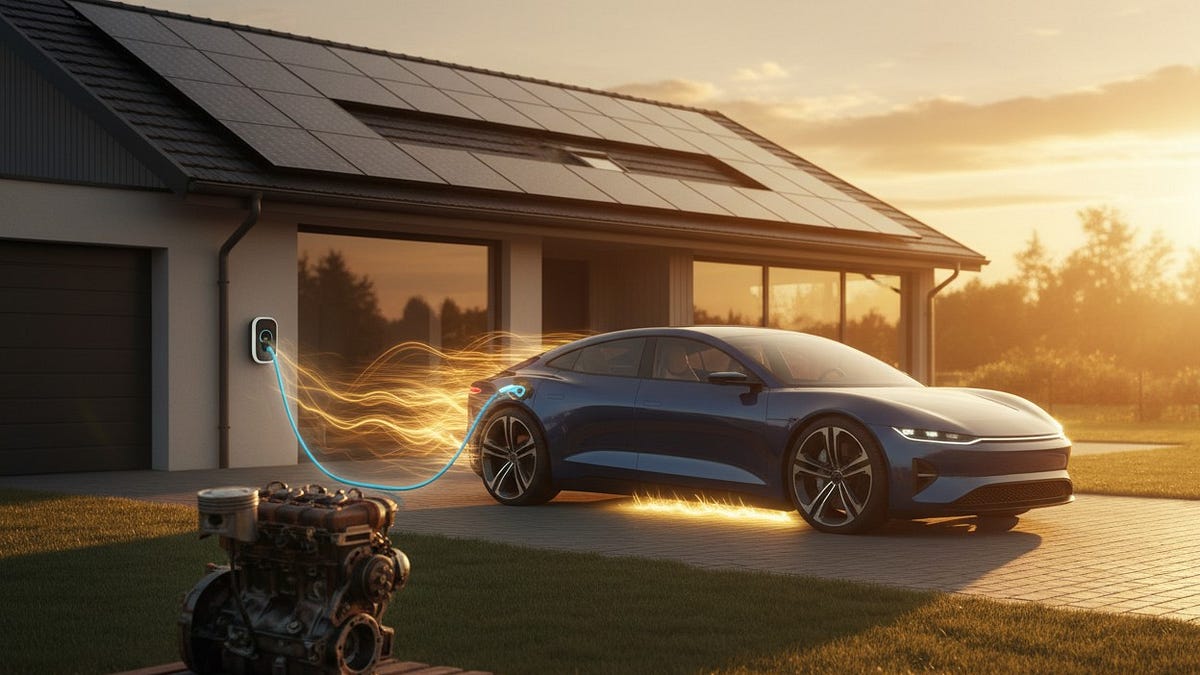
The incorrect us of words, language errors in context, notably misuse of past, present and future tense, incorrect wording, errors in spelling and punctuation = AI created chicom propaganda BS.China’s CATL 5C Battery Breakthrough: The Final Nail for the Combustion Engine
Introduction
True, but better batteries are coming, with the eventual forced use of electric vehicles.The incorrect us of words, language errors in context, notably misuse of past, present and future tense, incorrect wording, errors in spelling and punctuation = AI created chicom propaganda BS.
By the time these batteries are available we'll have solar active paint which will charge the batteriesPhysics says the amount of electricity available from solar panels does not do it for cars at their current size and weight.
You can get close with something like an Aptera. You can get close with limiting your trips to 30-40 miles twice a week, depending on weather.
Early on the writer cites the example of people unable to escape a natural disaster. I could not see where he returned to address that.
It's cloudy, stormy, and you ran around getting some essentials and your battery is depleted. You hear evac orders. Well. You are dead in the water. Nothing in the tech seems to address that. Seemed to be a sentence deliberately confabulating durability (number of charge cycles) with holding a charge and other desirable characteristics. I have to admit I stopped reading before halfway.
I wouldn’t know how to answer that. The efficiency of converting energy to useful work is pretty high with batteries, especially lithium but the problem is how the energy gets into the batteries in the first place. I’m not even sure how to phrase a question to an AI about it because it gets so wrapped up in so many different things. Maybe an engineer type here could answer?It's possible to scientifically calculate the heat+electromagnetic energy coming from the sun.
With internal combustion engines we do the same with the theoretical energy of gas and say it's been a steady progression better- from about 33% to at best around 45%. I know this came up with my corporate training at Mazda as they were leaders in pushing the upper end (with an engine that has been in production in other markets like the EU for 6-7 years, using compression ignition at certain parts of the drive cycles and a 16.3:1 Cr.)
It's also known around the more sciency end of the car hobby (speedtalk at its peak).
I remember reading at least a decade ago, battery tech was far more mature in that sense- the amount of current drawn from the "wall plug" was very little more than the amount in the battery. Among the issues was you didn't want to run the battery completely dead. And of course it was not a comparable thing to IC efficiency- you'd have to include inefficiencies in generation and distribution. So the numbers were subject to abuse by being taken out of context.
But what it importantly meant is if batteries were already in the 80% range, don't expect a miracle battery in the future.
The change from. say, high 80% to low mid 90% isn't a real world big gain. IDK if those are the true numbers. I hate searching because it's become such a political football, but numbers like that are what I remember.
Panoz, or any other reader- can you confirm some scientific statistics to confirm my recollections on that from a dozen years ago?
Granted batteries that last more charge cycles, weigh less, charge faster and especially cost less, do change the calculus in their own way, but there is a foundational reason for skepticism.
And what of solar power? Sure trees do pretty amazing things but even the very fastest ones like a Catalapa or a Poplar take 30+ years.
Accretive growth pales in comparison to the energy used for high speed, long distance travel of significant mass.
Are we capturing 1/3 of the entirety of solar? More, less?
I know there was an article, maybe here about a panel that could capture infrared radiation. To me- a novice to the science, it's just a different area of the spectrum, fine, ok. But I gather existing solar panels do their thing solely (no pun) with visible and shorter?
What do the numbers look like if we humans could capture the energy of the full spectrum?
If right now, we're capturing single digit percents of that, I'm interested.
But I think we are already higher than that, and it amounts to very little.
I'm biased not just as a car enthusiast, because solar panels here in the north are a joke. So I guess, yes, the numbers are going to be different in the South.