
1 / 10

Vigilante Parts
2 / 10

Dynamic
3 / 10

Pacific
4 / 10

Madcap
5 / 10

Bigtime Automotive
6 / 10

DHR Motorsports
7 / 10

Probe
8 / 10

ATD
9 / 10

Jesel
10 / 10

Precision

You are using an out of date browser. It may not display this or other websites correctly.
You should upgrade or use an alternative browser.
Weird science stuff
- Thread starter 99PanozAIV
- Start date


99PanozAIV
Platinum Member
- Joined
- Mar 10, 2020
- Messages
- 16,727
- Reaction score
- 34,891
- Points
- 153
The next virus on the list; had never heard of this one.
“Just like Ebolavirus, SARS, SARS-CoV-2, and Marburg virus, the Nipah pathogen originated in bats. The name Nipah is derived from the name of the Malaysian village where pig farmers were infected in the late 1990s. Measles virus, although not of bat origin, is another member of the paramyxovirus family and stands out as one of the most contagious viruses known to science. While Nipah is less contagious than measles, it is capable of much higher mortality.
People infected with Nipah virus can be afflicted with dangerous respiratory impairment and brain swelling, symptoms that fuel the extraordinary fatality rates. Mortality ranges from a low of 40% to a high of 90%. The virus has been responsible for several relatively recent outbreaks in Bangladesh and India.”

 medicalxpress.com
“Just like Ebolavirus, SARS, SARS-CoV-2, and Marburg virus, the Nipah pathogen originated in bats. The name Nipah is derived from the name of the Malaysian village where pig farmers were infected in the late 1990s. Measles virus, although not of bat origin, is another member of the paramyxovirus family and stands out as one of the most contagious viruses known to science. While Nipah is less contagious than measles, it is capable of much higher mortality.
People infected with Nipah virus can be afflicted with dangerous respiratory impairment and brain swelling, symptoms that fuel the extraordinary fatality rates. Mortality ranges from a low of 40% to a high of 90%. The virus has been responsible for several relatively recent outbreaks in Bangladesh and India.”
Scientists developing a monoclonal antibody to neutralize Nipah virus one of the deadliest zoonotic pathogens
An experimental monoclonal antibody has been engineered to target the deadly Nipah virus, an emerging zoonotic pathogen with a human mortality rate ranging as high as a staggering 90%.

AllRev
Gott mit uns
MoreThe next virus on the list; had never heard of this one.
“Just like Ebolavirus, SARS, SARS-CoV-2, and Marburg virus, the Nipah pathogen originated in bats. The name Nipah is derived from the name of the Malaysian village where pig farmers were infected in the late 1990s. Measles virus, although not of bat origin, is another member of the paramyxovirus family and stands out as one of the most contagious viruses known to science. While Nipah is less contagious than measles, it is capable of much higher mortality.
People infected with Nipah virus can be afflicted with dangerous respiratory impairment and brain swelling, symptoms that fuel the extraordinary fatality rates. Mortality ranges from a low of 40% to a high of 90%. The virus has been responsible for several relatively recent outbreaks in Bangladesh and India.”
Scientists developing a monoclonal antibody to neutralize Nipah virus one of the deadliest zoonotic pathogens
An experimental monoclonal antibody has been engineered to target the deadly Nipah virus, an emerging zoonotic pathogen with a human mortality rate ranging as high as a staggering 90%.
 batshit BS
I read a theory that bats in the caves in the SW carried diseases that may have wiped out the Pueblo/Navajo types back in the day. Not an especially accepted or learnedly expressed theory, but it seemed as plausible as much of the other speculation that is on that.More
So I don't blow off all bat related talk as MSM propaganda.
Last edited:
99PanozAIV
Platinum Member
- Joined
- Mar 10, 2020
- Messages
- 16,727
- Reaction score
- 34,891
- Points
- 153
It’s weird how many dangerous viruses are associated with bats. Their communal living arrangements likely means that stuff is constantly circulating within the colonies and becomes very adapted to bats. Ebola, IIRC, has little to no effect on bats but they can carry and transmit it.I read a theory that bats in the caves in the SW carried diseases that may have wiped out the Pueblo/Navajo types back in the day. Not an especially accepted or learnedly expressed but but seemed as plausible as much of the other speculation that is that.
So I don't blow off all bat related talk as MSM propaganda.

Oldest living culture: Our new research shows an Indigenous ritual passed down for 500 generations
We often hear that Aboriginal peoples have been in Australia for 65,000 years, "the oldest living cultures in the world." But what does this mean, given all living peoples on Earth have an ancestry that goes back into the mists of time?
an Indigenous ritual passed down for 500 generations
very particular cultural knowledge and practice for some 500 generations.
99PanozAIV
Platinum Member
- Joined
- Mar 10, 2020
- Messages
- 16,727
- Reaction score
- 34,891
- Points
- 153

Team discovers potential drug target for the lethal wasting disease known as cancer cachexia
Cancer is insidious. Throughout tumor progression, the disease hijacks otherwise healthy biological processes—like the body's immune response—to grow and spread. When tumors elevate levels of an immune system molecule called Interleukin-6 (IL-6), it can cause severe brain dysfunction. In about...
99PanozAIV
Platinum Member
- Joined
- Mar 10, 2020
- Messages
- 16,727
- Reaction score
- 34,891
- Points
- 153
This is cool. I really like when people go and take a fresh look at something that has been around for decades.
“Put simply, the paper revealed that a bacitracin molecule has five points that make contact with the bacterial cell membrane. You could compare them to arms, reaching out and grabbing hold of the bacteria.
"It made me wonder as a chemist: what would happen if we could make these arms longer and more sticky? Would they be able to bind better with the cell and make the antibiotic more effective?"
Keep in mind that antibiotics are typically produced by soil-dwelling microorganisms. That means they are not necessarily optimized for use as medicines in the human body. Some classes of antibiotics, such as the penicillins, have been synthetically improved by medicinal chemists over the years. But bacitracin is still used in its natural, unchanged form. That means its full potential might not yet have been unlocked.”

 phys.org
“Put simply, the paper revealed that a bacitracin molecule has five points that make contact with the bacterial cell membrane. You could compare them to arms, reaching out and grabbing hold of the bacteria.
"It made me wonder as a chemist: what would happen if we could make these arms longer and more sticky? Would they be able to bind better with the cell and make the antibiotic more effective?"
Keep in mind that antibiotics are typically produced by soil-dwelling microorganisms. That means they are not necessarily optimized for use as medicines in the human body. Some classes of antibiotics, such as the penicillins, have been synthetically improved by medicinal chemists over the years. But bacitracin is still used in its natural, unchanged form. That means its full potential might not yet have been unlocked.”
How to make an old antibiotic 100 times more potent
Nathaniel Martin, Professor of biological chemistry, wondered what would happen if you took an antibiotic that has been known for 70 years and tried to improve it with the latest tools of modern chemistry. Turns out it can become up to a hundred times more potent and prevent the growth of some...

Battery
White Devil
- Joined
- Jan 13, 2021
- Messages
- 5,792
- Reaction score
- 11,353
- Points
- 153
Finally: Science Makes Suit That Lets You Drink Your Own Piss - Daily Stormer
There are two things I've dreamed of in this world: a Europe completely populated by Africans, and a
 dailystormer.in
99PanozAIV
Platinum Member
- Joined
- Mar 10, 2020
- Messages
- 16,727
- Reaction score
- 34,891
- Points
- 153
For nearly 2 centuries, we have believed cells divide in one of two way, meiosis or mitosis. Now they’ve discovered cells can divide by a 3rd pathway.
Elon entered everybody in the space satellite lottery. Did any chunks fall on you or where you could find some?
https://www.cbsnews.com/news/spacex-falcon-9-second-stage-engine-catastrophic-in-flight-failure/
20 STARLINK SATELLITES WERE LOST: Jonathan McDowell of Harvard University reports that all 20 Starlink satellites launched on July 11th have re-entered Earth's atmosphere. A failure in SpaceX's Falcon 9 rocket caused the satellites to be deployed lower than usual, too low to escape the drag of the atmosphere below. Right now, our atmosphere is extra-puffed up by high solar activity, so the satellites were doomed despite "warp 9" thuster firings. If you witnessed any of the re-entries, please submit your images here.
99PanozAIV
Platinum Member
- Joined
- Mar 10, 2020
- Messages
- 16,727
- Reaction score
- 34,891
- Points
- 153
“Physicists at the University of Stuttgart under the leadership of Prof. Sebastian Loth are developing quantum microscopy which enables them for the first time to record the movement of electrons at the atomic level with both extremely high spatial and temporal resolution.
Their method has the potential to enable scientists to develop materials in a much more targeted way than before. The researchers have published their findings in Nature Physics.
“With the method we developed, we can make things visible that no one has seen before," says Prof. Loth, Managing Director of the Institute for Functional Matter and Quantum Technologies (FMQ) at the University of Stuttgart. "This makes it possible to settle questions about the movement of electrons in solids that have been unanswered since the 1980s." The findings of Loth's group are also of very practical significance for the development of new materials.”

 phys.org
Their method has the potential to enable scientists to develop materials in a much more targeted way than before. The researchers have published their findings in Nature Physics.
“With the method we developed, we can make things visible that no one has seen before," says Prof. Loth, Managing Director of the Institute for Functional Matter and Quantum Technologies (FMQ) at the University of Stuttgart. "This makes it possible to settle questions about the movement of electrons in solids that have been unanswered since the 1980s." The findings of Loth's group are also of very practical significance for the development of new materials.”
Quantum microscopy study makes electrons visible in slow motion
Physicists at the University of Stuttgart under the leadership of Prof. Sebastian Loth are developing quantum microscopy which enables them for the first time to record the movement of electrons at the atomic level with both extremely high spatial and temporal resolution.
Last edited:
Battery
White Devil
- Joined
- Jan 13, 2021
- Messages
- 5,792
- Reaction score
- 11,353
- Points
- 153
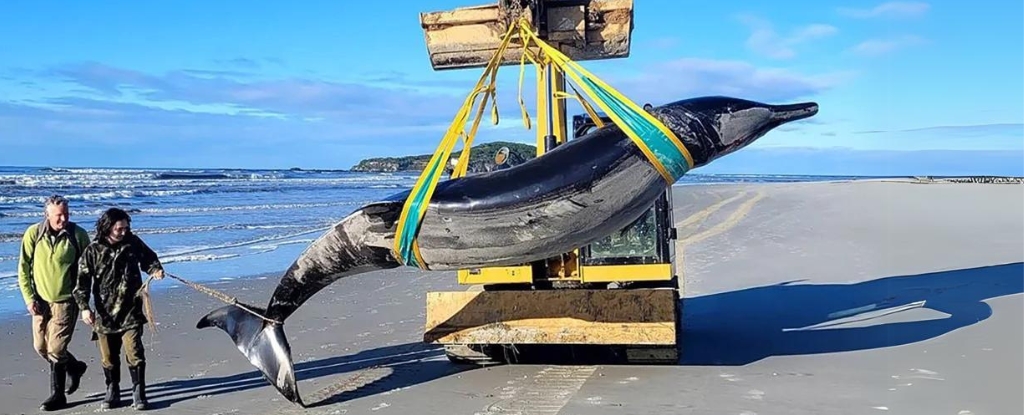
World's Rarest Whale, Never Seen Alive, Washes Up on Beach
The body of a spade-toothed whale – a species so rare it has never been seen alive – appears to have washed up on a New Zealand beach, scientists say.
 www.sciencealert.com
99PanozAIV
Platinum Member
- Joined
- Mar 10, 2020
- Messages
- 16,727
- Reaction score
- 34,891
- Points
- 153

Maybe we don’t have anything to worry about if A.I.s decide to make a go of it alone.
”Shumailov and colleagues also investigated how AI models responded to a training dataset that was predominantly created with artificial intelligence. They found that feeding a model AI-generated data causes successive generations to degrade in their ability to learn, eventually leading to model collapse.
Nearly all of the recursively trained language models they tested tended to display repeating phrases. For example, a test was run using text about medieval architecture as the original input and by the ninth generation the output was a list of jackrabbits.
The authors propose that model collapse is an inevitable outcome of AI models that use training datasets created by previous generations. In order to successfully train artificial intelligence with its own outputs, Shumailov and colleagues suggest that training a model with AI-generated data is not impossible, but the filtering of that data must be taken seriously.”

Using AI to train AI: Model collapse could be coming for LLMs, say researchers
Using AI-generated datasets to train future generations of machine learning models may pollute their output, a concept known as model collapse, according to a new paper published in Nature. The research shows that within a few generations, original content is replaced by unrelated nonsense...
lola test was run using text about medieval architecture as the original input and by the ninth generation the output was a list of jackrabbits
In other words, the same result as the last 50 years of public school "education" provided by the NEA and the Dept. of Education.
Maybe we don’t have anything to worry about if A.I.s decide to make a go of it alone.
”Shumailov and colleagues also investigated how AI models responded to a training dataset that was predominantly created with artificial intelligence. They found that feeding a model AI-generated data causes successive generations to degrade in their ability to learn, eventually leading to model collapse.
Nearly all of the recursively trained language models they tested tended to display repeating phrases. For example, a test was run using text about medieval architecture as the original input and by the ninth generation the output was a list of jackrabbits.
The authors propose that model collapse is an inevitable outcome of AI models that use training datasets created by previous generations. In order to successfully train artificial intelligence with its own outputs, Shumailov and colleagues suggest that training a model with AI-generated data is not impossible, but the filtering of that data must be taken seriously.”
Using AI to train AI: Model collapse could be coming for LLMs, say researchers
Using AI-generated datasets to train future generations of machine learning models may pollute their output, a concept known as model collapse, according to a new paper published in Nature. The research shows that within a few generations, original content is replaced by unrelated nonsense...techxplore.com
So it's like trying to get NAPAs to learn. Got it
Maybe we don’t have anything to worry about if A.I.s decide to make a go of it alone.
”Shumailov and colleagues also investigated how AI models responded to a training dataset that was predominantly created with artificial intelligence. They found that feeding a model AI-generated data causes successive generations to degrade in their ability to learn, eventually leading to model collapse.
Nearly all of the recursively trained language models they tested tended to display repeating phrases. For example, a test was run using text about medieval architecture as the original input and by the ninth generation the output was a list of jackrabbits.
The authors propose that model collapse is an inevitable outcome of AI models that use training datasets created by previous generations. In order to successfully train artificial intelligence with its own outputs, Shumailov and colleagues suggest that training a model with AI-generated data is not impossible, but the filtering of that data must be taken seriously.”
Using AI to train AI: Model collapse could be coming for LLMs, say researchers
Using AI-generated datasets to train future generations of machine learning models may pollute their output, a concept known as model collapse, according to a new paper published in Nature. The research shows that within a few generations, original content is replaced by unrelated nonsense...
CHINA LAUNCHES NEW SATELLITE MEGACONSTELLATION: Earth orbit is about to get a lot more crowded. On Aug. 6th, China launched the first 18 satellites of its new Thousand Sails megaconstellation. Sky watchers in the USA watched it happen as the the booster stage of the Long March rocket created a spectacular display across the midwest:

"I did not see it in person," says Dan Bush, of Albany, Missouri. "But my automated camera was monitoring the sky for Perseids. In the morning when I checked the footage for meteors, I discovered I had recorded this remarkable event."
Pilot Alexander Goroshko of Westjet Airlines witnessed the display from a plane flying over Denver at 39,000 ft. "It looked amazing from the flight deck," he says. Another pilot, Marc Livolsi, saw it twice over Ft. Dodge, Iowa, and one orbit later over Jackson, Wyoming.
The comet-like plumes are fuel dumped by the rocket booster as a safety precaution before re-entering Earth's atmosphere. SpaceX does this all the time; their fuel dumps and deorbit burns frequently look like spirals because the rockets spin to release the Starlink satellites. This may be a case of a spiral viewed at an angle.
Thousand Sails is a Chinese initiative to compete with Starlink. Officials say that 108 satellites are planned for launch this year in separate batches of 36 and 54 satellites; another 500+ are planned for 2025. Ultimately the megaconstellation will contain more than 14,000 satellites (Starlink currently has about 6,200).

A Long March-6 rocket carrying 18 Thousand Sails satellites blasts off from the Taiyuan Satellite Center in China's Shanxi Province on Aug. 6, 2024.
Environmentalists have raised many concerns about Starlink including light-pollution of the night sky, a potentially hazardous traffic jam in low-Earth orbit, metallic contamination of the stratosphere, and even ozone depletion. Thousand Sails and a second proposed Chinese megaconstellation named "SatNet" (13,000 satellites) will only multiply these concerns.
Meanwhile, sky watchers have another phenomenon to track. If you photographed the Thousand Sails fuel dump, please submit your pictures here.
more images: from Clint Parrish of Sullivan, Illinois; from David Hasenauer in the White Mountains near Bishop, California;
"I did not see it in person," says Dan Bush, of Albany, Missouri. "But my automated camera was monitoring the sky for Perseids. In the morning when I checked the footage for meteors, I discovered I had recorded this remarkable event."
Pilot Alexander Goroshko of Westjet Airlines witnessed the display from a plane flying over Denver at 39,000 ft. "It looked amazing from the flight deck," he says. Another pilot, Marc Livolsi, saw it twice over Ft. Dodge, Iowa, and one orbit later over Jackson, Wyoming.
The comet-like plumes are fuel dumped by the rocket booster as a safety precaution before re-entering Earth's atmosphere. SpaceX does this all the time; their fuel dumps and deorbit burns frequently look like spirals because the rockets spin to release the Starlink satellites. This may be a case of a spiral viewed at an angle.
Thousand Sails is a Chinese initiative to compete with Starlink. Officials say that 108 satellites are planned for launch this year in separate batches of 36 and 54 satellites; another 500+ are planned for 2025. Ultimately the megaconstellation will contain more than 14,000 satellites (Starlink currently has about 6,200).
A Long March-6 rocket carrying 18 Thousand Sails satellites blasts off from the Taiyuan Satellite Center in China's Shanxi Province on Aug. 6, 2024.
Environmentalists have raised many concerns about Starlink including light-pollution of the night sky, a potentially hazardous traffic jam in low-Earth orbit, metallic contamination of the stratosphere, and even ozone depletion. Thousand Sails and a second proposed Chinese megaconstellation named "SatNet" (13,000 satellites) will only multiply these concerns.
Meanwhile, sky watchers have another phenomenon to track. If you photographed the Thousand Sails fuel dump, please submit your pictures here.
more images: from Clint Parrish of Sullivan, Illinois; from David Hasenauer in the White Mountains near Bishop, California;
