Weird science stuff

This makes too much sense. Why did it take so long? Once a satellite is in orbit it could be made of balsa wood, cardboard and fiberglass.

A neighbor used that to make a sailing outrigger with a 30' main hull with a 15' outrigger and the wing between, total weight only 300 lbs. It had 300 sq.ft. of sail and easily outran Hobie cats. I guess carbon fiber makes wood obsolete.

 
Last edited:
“When trying to measure molecular structures with nanometer precision, every bit of noise shows up in the data: someone walking past the microscope, tiny vibrations in the building and even the traffic outside. A new processing technique removes noise from optical microscope data in real time, allowing scientists to track individual molecules over 10 times more precisely than was possible before.”
…
“At first, we just wanted to develop a fast algorithm because our lab produces too much data for traditional algorithms to handle, but we found that AIM can also achieve sub-nanometer precision, which is unheard of in our field," said Hongqiang Ma, a research professor of bioengineering and the study's lead author. "In addition, it doesn't require immense computing power like traditional tools. It can run on a laptop. We want to make this a plug-and-play tool for all microscope users."

In recent decades, the single-molecule localization microscopy technique has enabled scientists to visualize molecular-scale structures, surpassing what was thought to be a fundamental limitation of optical microscopes. However, it is limited in practice by uncontrollable noise, or "drift," that essentially blurs the images and prevents super-resolution microscopy from reaching its highest resolution.”

Could be a kin of or a development from the algorithm used astronomical telescopes for reducing optical aberrations caused by the atmosphere?

Reminds me of using a sensitive DVM in a room full of florescent lights
 
Cool, a potted air purifier…

"It's the equivalent of up to 30 regular houseplants in terms of air purification," said Lionel Mora, co-founder of startup Neoplants.

"It will not only capture, but also remove and recycle, some of the most harmful pollutants you can find indoors."

 
I am undecided what to think about this. I’ve heard plenty of warnings from lots of different sources but am confused as to how it works. I was under the impression that AI, and especially general AI, required massive computer power in which case an AI would be an easy target. Or is it that the algorithms are not that large and they only need to have access to large data sets? If the operating software is small and could be widely distributed, then I see where it could be a problem. Anyone know what the deal is?
 
I am undecided what to think about this. I’ve heard plenty of warnings from lots of different sources but am confused as to how it works. I was under the impression that AI, and especially general AI, required massive computer power in which case an AI would be an easy target. Or is it that the algorithms are not that large and they only need to have access to large data sets? If the operating software is small and could be widely distributed, then I see where it could be a problem. Anyone know what the deal is?
So, to maybe answer my own question, it looks like the main components to an AI can reside on a pretty small device, like an iPhone. In that case, I can see the case for alarm over AI. Apple’s Siri is getting ready to be supplemented with AI.

”Apple’s LLM is expected to handle basic AI tasks entirely on-device, processing the model using only the iPhone’s processor, with no need for a cloud connection. While we don’t know what will be considered to be basic AI tasks, the LLM is said to contain code that decides if a request can be processed locally or will require access to Apple’s cloud servers.”

 
redflare_strip_opt.gif

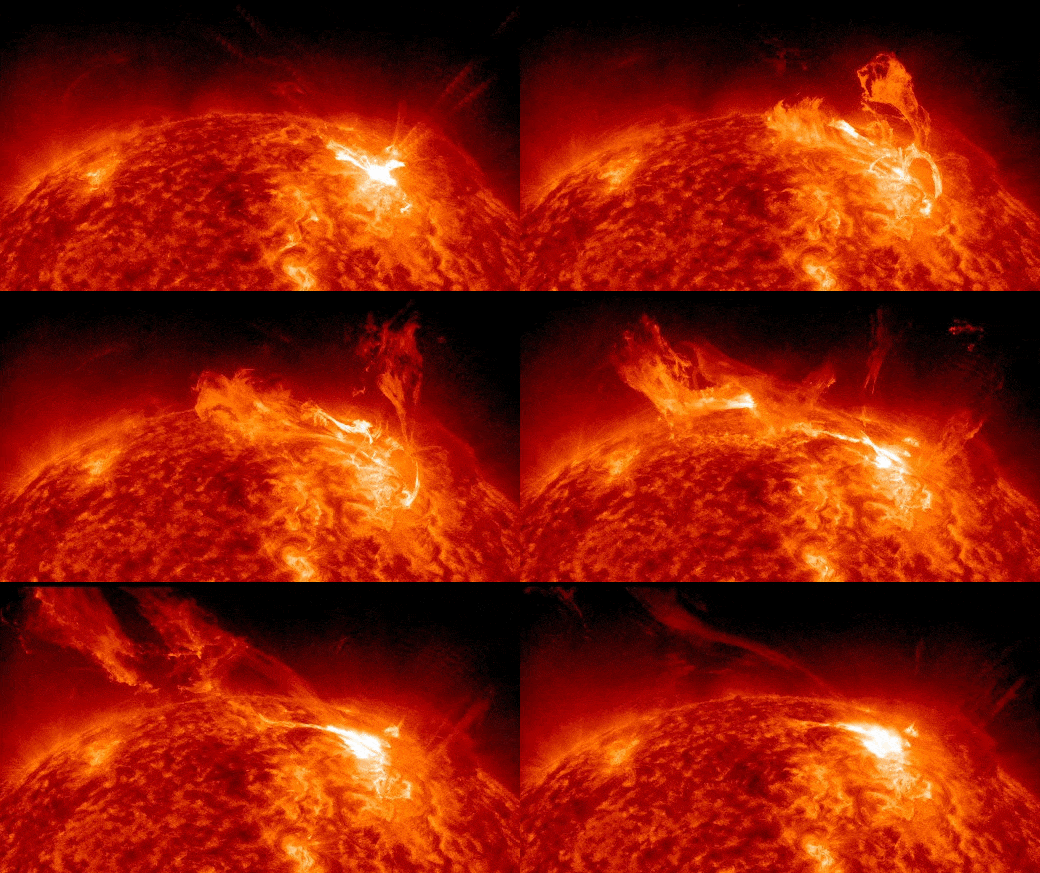
SOLAR FLARE AND HARD RADIATION STORM: Sunspot AR3664 just did it again. The record-setting active region produced another very strong solar flare on June 8th (0149 UT), hurling a massive plume of plasma into space:

This was an category M9.7 event, only percentage points from X-class. Radiation from the flare ionized the top of Earth's atmosphere, causing a deep shortwave radio blackout across the western Pacific Ocean: map.

The sunspot is currently located in a region of the sun that is magnetically well-connected to Earth. As a result, protons accelerated by the explosion are spiralling toward us, peppering the top of Earth's atmosphere as well as all spacecraft near our planet. Here's an example of the effect this can have:
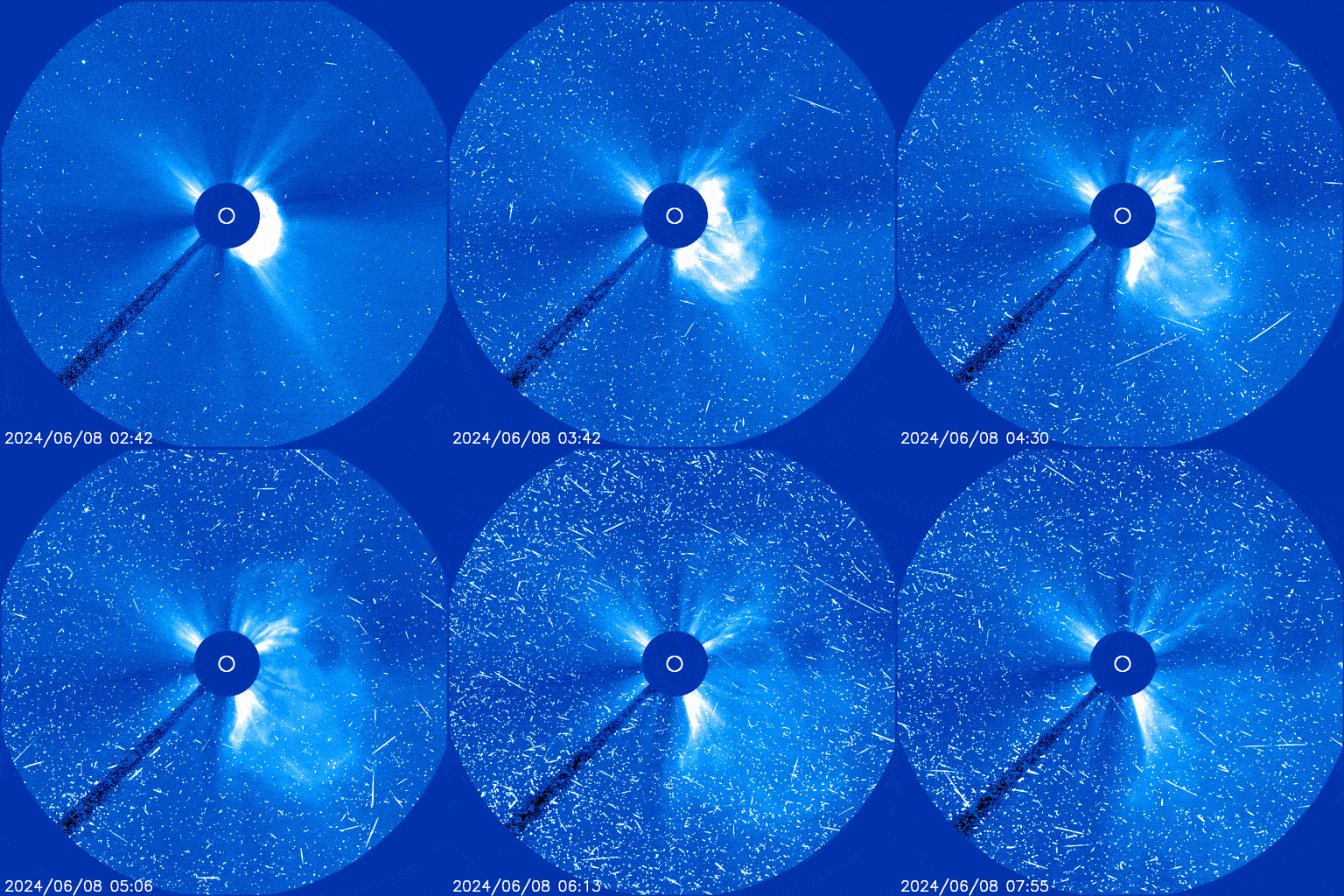
cme_anim_opt.gif

Every speck of 'snow' in this SOHO coronagraph movie is caused by an energetic proton striking the spacecraft's camera. Through the fog you can see a bright CME emerging from the blast site. It will sideswipe Earth on June 10th.

At the moment the radiation storm is category S1 (Minor), several levels below the peak of the scale. It does not pose a biological threat to astronauts or air travelers.

Nevertheless, this storm is interesting because it contains an unusually high fraction of "hard" protons with high energies > 100 MeV. Hard protons are good at charging spacecraft bodies, fogging their cameras, and causing reboots of onboard computers. It would not be a surprise to hear reports of minor satellite problems in the days ahead. Solar flare alerts: SMS Text


"Earth suddenly was outside the protective bubble," says Merav Opher of Boston University, the paper's lead author. "Earth and all the planets were exposed to massive amounts of hydrogen, increased radiation, and interstellar dust."

Researchers have long wondered if something happened to Earth 2 to 3 million years ago. Deep-sea sediments, Antarctic snow, and lunar samples from that time period all contain extraterrestrial radioactive isotopes (iron-60 and plutonium-244). The peak is quite striking.

A nearby supernova might have peppered Earth with these substances, but Opher and colleagues had a different idea. In the constellation Lynx there is a ribbon-shaped cluster of dense interstellar clouds. Using a velocity model for the clouds, they found that the sun and at least one of the clouds may have crossed paths 2 to 3 million years ago

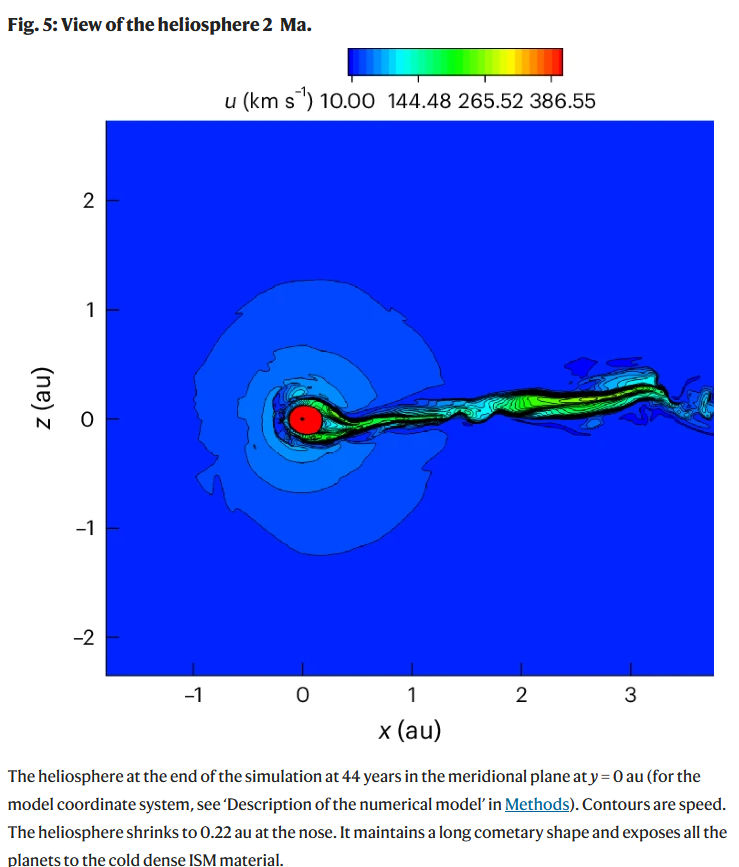
"We show that during the cloud's passage, the heliosphere shrinks to a scale of 0.22 AU, smaller than the Earth's orbit around the sun," says Opher. According to their simulation, the helioshere was compressed and stretched into a tadpole-like structure with Earth's orbit (red circle) on the outside:


There is some evidence that Earth cooled while it was outside the heliosphere. Deep in our oceans, fossils of tiny marine organisms known as foraminifera preserve ancient climate data. Oxygen isotopes in those fossils suggest the temperature dropped 2–3 million years ago. Could this be a result of interstellar gas and cosmic rays altering our atmosphere?

"This idea should be revisited with modern atmospheric modelling," the authors urge.

Eventually, the cloud passed and the heliosphere bounced back. Earth was inside its protective bubble again. "That's where we are now," says Opher. It's a good place to be.

Want to learn more? Read the original research.

 
Last edited:
They’ve also been working on hybrids of nerve cells and ICs. Here’s a reprint a few years old where they’ve grown nerve cells right on a chip, in this case, for better cellular measurements.

 
Back
Top