Weird science stuff

In September 2023 during a debate over an appropriations bill, Thomas Massie (R, rep, Kentucky - since 2012) highlighted an incident in which an edible vaccine was introduced into a corn crop used to feed pigs in order to mitigate diarrhea. The corn crop, however, became commingled with a soybean crop - contaminating 500,000 bushels that had to be recalled.

"Do we want humans eating vaccines that were grown in corn meant to stop pigs from getting diarrhea? I don’t think we want that to happen. Yet that almost happened, and it could happen," said Massie. "There is another case where the pollen cross-contaminated another crop of corn, and 155 acres of corn had to be burned. What are the cases where we’re not discovering this? I think it’s dangerous to play God with our food."
Did we know this is already out there in action?
I thought it was somewhat theoretical still.
These un-wise people doing this are usually so hyper confident they would approve hiding the failures in the blink of an eye. That recalls are happening, and burning of crops, tells me there's a shit show going on, where those cases are just where they couldn't hide it.
This gives me kind of a sick feeling in my gut.
 
Shameless copy and paste from after comments in Zero Hedge. https://www.zerohedge.com/military/...rne-division-receives-next-gen-assault-rifles

This comment:
E=mc^2 is same as momentum P=mv^2 which is also energy.
So, yeah....

Prompted this:
Momentum is not energy. It is a derivative of energy. P=mv (there is no squared term).

Kinetic Energy (KE) = 1/2mv^2 (this is where you're getting confused).

E=mc^2 is the amount of energy contained in the rest mass of an object or particle. In order to include the energy of any motion, you need to add a term to the equation: E = mc^2 + 1/2mv^2

'm' is the rest mass in all cases and remains unchanged, but the apparent mass of an object increases as kinetic energy is added (as it speeds up). In other words, mass and energy are completely interchangeable and are manifestations of the same thing.

Unconfined energy (like light) has zero rest mass and must travel at the speed of causality (c) through space. It travels at zero velocity through time.

Confined energy, such as the binding energy between quarks which make up all baryonic matter (neutrons & protons etc), manifests as mass when under extreme confinement (massless gluons exchange colour charge information between quarks at the speed of light and are responsible for the Strong force). This binding energy makes up more than 98% of the mass of the proton, only about 2% comes from the quarks rest mass. All objects with non-zero rest mass must travel below speed c through space and at the maximum possible speed through time, such that the magnitude of their four-velocity through 4-dimentional spacetime is always equal to c. In other words, if a massive object is at rest, it will travel at speed c through time. If it is moving then it will travel through time more slowly (it's a trade off, basically).

Einstein was a genius. You should have more respect.

~~~~~ end quote ~~~~~
 
Looks like Starlink might soon have so many satellites up we won't be able to see the stars.

STARLINK VS. COMET 12P: https://www.spaceweather.com/archive.php?view=1&day=03&month=04&year=2024


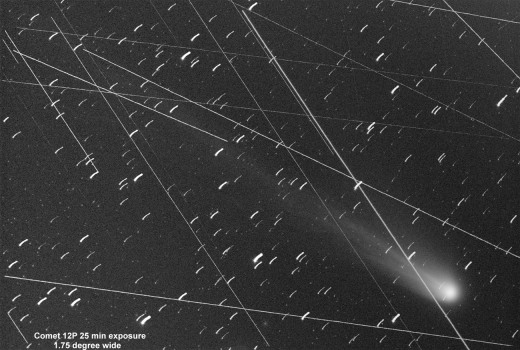
carpetbombed_strip.jpg


This is a great week to photograph Comet 12P/Pons-Brooks in the evening sky. The comet is almost 4th magnitude, an easy target for small telescopes and cameras, and there is no Moon to interfere with a long exposure. Just one problem: Starlink. "I tried to image the comet on March 28th," reports Richard Schrantz of Nicholasville, KY. "Even though the field of view is just 1.75 degrees wide, I was carpet-bombed by satellites!"

"This (picture above) represents only 25 minutes of exposure," says Schrantz. "Thanks, Starlink (and/or other satellites)."

Comet 12P is especially vulnerable to this kind of "carpet-bombing." The reason has to do with the comet's location and time of day. The best time to see 12P is just after sunset when the comet may be found hanging low in the western sky. This is also the best time to see satellites, which shine in high altitude sunlight after night falls on the ground below.

If you do photograph 12P, try taking a series of short exposures, then discard the ones (if any) criss-crossed by satellites. Combining the "clean" shots can produce an image like this:

12p_and_hamil_strip.jpg


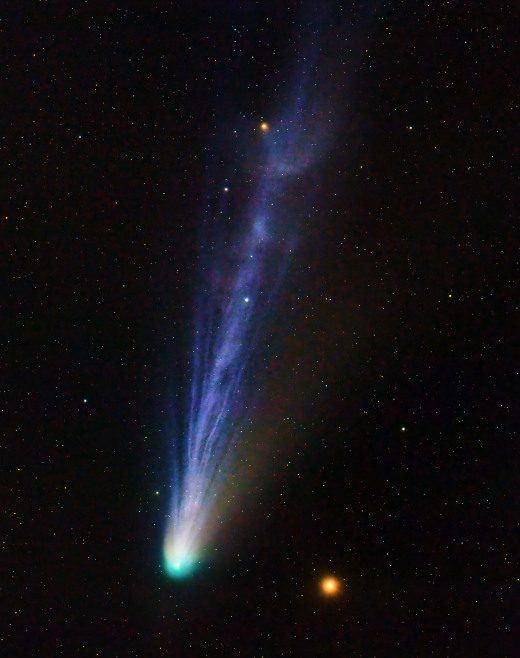
"This is a 32 min exposure in 15 sec single shots," says Fritz Helmut Hemmerich, who observed the comet from Tenerife in the Canary Islands on March 31st. "The comet looked great as it passed near the yellow-orange star Hamal (mutton in Arabic) in the constellation Aries. I'm very happy to get this shot with such modest equipment."

Satelites aside, Comet 12P is a great target for amateur astrophotographers. It will be in the evening sky all week long, and might even be visible during the April 8th solar eclipse. Point your optics here, or find it using one of these sky maps: April 3, 4, 5, 6, 7, 8, 9, 10


more images: from Michael Jaeger of Aicha, Bavaria; from Jeremy Perez of Flagstaff, Arizona; from Danilo Pivato of Maremma Toscana, Italy


links in this to other interesting things


cliffsnotes: --> The huge Tonga volcano eruption two years ago increased water vapour into the upper atmosphere by 10 per cent and (according to climate alarmists) should have had a deleterious warming effect on the climate ... but, for the warmers, no warming, no joy.
 
When dad was doing electrical maintenence work for the Potash mine outside of Saskatoon Saskatchewan, they found a shark skeleton in the earth, several hundred meters downhole, if not further.
Travel through NoDak in winter and you wouldn't be surprised to see a mammoth walk out on the road in front of you. :p
Shark in Sask is actually more surprising in that sense.
 
Sharks don't have bones, only cartilage. I don't know what they found, but it wasn't a shark. If it were, all they'd find is teeth.
Could have been a jaw, then, yeah. IDK . I heard the story in the early 80's.
Some large chunk of this below and you'd stop the workflow. Probably you'd be assuming it was a dino, but either way.

 
Maybe not weird but sloppy, self-serving writing. It was interesting at first but then the author had to get political and make a fool of himself.

“With changes in climate happening and predicted to worsen, earthworms face an uncertain future.

This should concern everyone—our future is interlocked with that of earthworms.”

https://phys.org/news/2024-04-secret-world-earthworms-tiger-worm.html

Really? Guess what? We got along just fine without earthworms. They are an invasive species in North America.

”Earthworms are shifting their ranges northwards into forests between 45° and 69° latitude in North America that have lacked native earthworms since the last ice age.[3]”

 
Not really weird but very cool…

 
Oh, good, so we just need to get animals to stop eating bat shit.

“The study was prompted when Dr. Pawel Fedurek observed wild chimpanzees consume bat guano from a tree hollow in Budongo Forest, Uganda.”

”"Most research into outbreaks and pandemics has focused on curtailing the spread of the virus, by finding an effective vaccine for example, rather than preventing animal-to-human virus transmission from happening in the first place. Our work stresses the importance of studying disease ecology before diseases enter humans."”

 
…and now, for the completely unexpected, plastic production leads to plastic pollution!


Scientists have discovered the maximum age a human can live to​

"Research conducted in The Netherlands has found that the maximum ceiling life span for a female is 115.7 years."

That's it. The ceiling is 115.7 years.

The title of the oldest person ever recorded belongs to Jeanne Louise Calment. Born on February 21, 1875, her life spanned 122 years and 164 days.

Trust the Science ...
 
Last edited:
H5N1 Avian Influenza virus changing and seems to be spreading rapidly among different mammals.

“Last week Chile said that nearly 9,000 sea lions, penguins, otters, porpoises and dolphins have died from bird flu along its north coast since the start of the year.

Most mammals are believed to have contracted the virus by eating an infected bird.

But Webby said that what "scares us the most" are indications from a Spanish mink farm, or among sea lions off South America, that the virus could be transmitting between mammals.

Ian Brown, virology head at the UK's Animal and Plant Health Agency, said there has not yet been "clear evidence that this virus is easily sustaining in mammals."

While the virus is changing to become "more efficient and more effective in birds," it remains "unadapted to humans," Brown told AFP.

Avian viruses bind to different receptors on the host cell than human viruses, Webby said.

It would take "two or three minor changes in one protein of the viruses" to become more adapted to humans, he said.

"That is what we're really looking out for."”

 
Back
Top