Watch out forNow, in the latest news, LSD is good for you!

FDA: LSD Is Now a Breakthrough Therapy
Mind Medicine's anxiety-treating MM120 granted designation ahead of Phase 3 trialswww.newser.com

1 / 10

Vigilante Parts
2 / 10

Dynamic
3 / 10

Pacific
4 / 10

Madcap
5 / 10

Bigtime Automotive
6 / 10

DHR Motorsports
7 / 10

Probe
8 / 10

ATD
9 / 10

Jesel
10 / 10

Precision

You are using an out of date browser. It may not display this or other websites correctly.
You should upgrade or use an alternative browser.
You should upgrade or use an alternative browser.
Weird science stuff
- Thread starter 99PanozAIV
- Start date
99PanozAIV
Platinum Member
- Joined
- Mar 10, 2020
- Messages
- 16,726
- Reaction score
- 34,886
- Points
- 153
If you don’t want to eat bugs, how about snakes? Sounds like it might be good.
“"In terms of food and protein conversion ratios, pythons outperform all mainstream agricultural species studied to date," Dr. Natusch says.
"We found pythons grew rapidly to reach 'slaughter weight' within their first year after hatching."
"There are clear economic and adaptability benefits to farmers who raise pythons rather than raising pigs," Professor Shine says.”
…
"Birds and mammals waste about 90% of the energy from the food they eat, simply maintaining a constant body temperature," says Professor Shine.
"But cold-blooded animals like reptiles just find a spot in the sun to get warm. They are hugely more efficient at turning the food they eat into more flesh and body tissue than any warm-blooded creature ever could."”

 phys.org
“"In terms of food and protein conversion ratios, pythons outperform all mainstream agricultural species studied to date," Dr. Natusch says.
"We found pythons grew rapidly to reach 'slaughter weight' within their first year after hatching."
"There are clear economic and adaptability benefits to farmers who raise pythons rather than raising pigs," Professor Shine says.”
…
"Birds and mammals waste about 90% of the energy from the food they eat, simply maintaining a constant body temperature," says Professor Shine.
"But cold-blooded animals like reptiles just find a spot in the sun to get warm. They are hugely more efficient at turning the food they eat into more flesh and body tissue than any warm-blooded creature ever could."”
Snakes: The new, high-protein superfood
Farmed pythons may offer a sustainable and efficient new form of livestock to boost food security, according to new research from Macquarie University.

Mike Swann
Q̇=ṁCpΔT
I ate rattlesnake in Midland TX once, tasted just like chicken.
99PanozAIV
Platinum Member
- Joined
- Mar 10, 2020
- Messages
- 16,726
- Reaction score
- 34,886
- Points
- 153
I haven’t had snake but I’ve had frog legs and gator tail, both were tasty.I ate rattlesnake in Midland TX once, tasted just like chicken.

THE POLAR VORTEX IS SPINNING BACKWARDS: Earlier this month, atmospheric scientists noticed something unusual in the Arctic stratosphere. The polar vortex was spinning backward.
"The vortex changed direction around March 4th," reports Dr. Amy Butler, author of NOAA's Polar Vortex Blog. "It was a substantial reversal, reaching -20.5 m/s a few days ago, which puts it in the top 6 strongest such events since 1979."
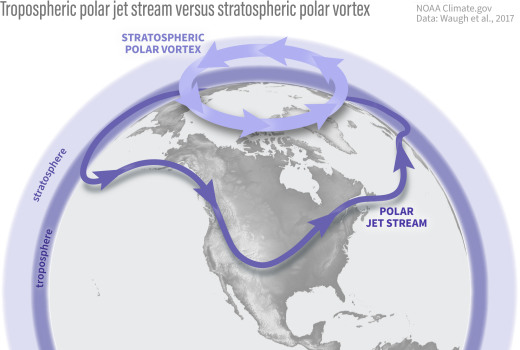
Two weeks later, it is still spinning backwards. What's going on?
"Atmospheric planetary waves have been breaking in the polar stratosphere, increasing its temperature," says Butler. "We call this a 'Sudden Stratospheric Warming' event, and it can cause the vortex to change direction.'"
In recent years, many people have heard the phrase "polar vortex" because of the effect it can have on winter weather. When the polar vortex is strong and stable, it helps confine cold air to polar regions. When the vortex weakens or becomes disturbed, cold air spills out to lower latitudes.
This month's backward vortex has *not* caused an outbreak of winter weather. Instead, it has produced a very strong increase in polar ozone.
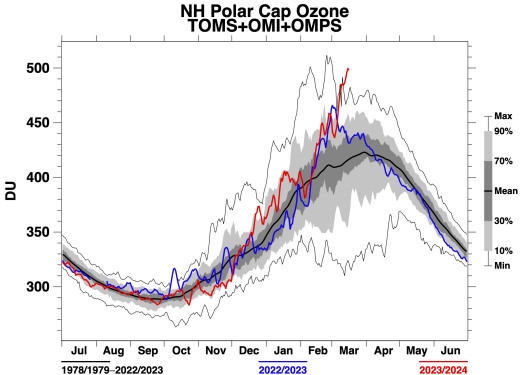
"Sudden Stratospheric Warming events accelerate the transport of ozone from the tropics to the poles," explains Butler. "Also, warming air helps prevent chemical ozone loss."
The current 'ozone spike' -- the opposite of an ozone hole -- is the biggest in the month of March since record-keeping began in 1979.
Soon, things could return to normal. The vortex's backward-spin is slowing, and "could become westerly again in about 10 days," says Butler. If so, the ozone spike will subside.
Stay tuned for updates from the stratosphere.
"The vortex changed direction around March 4th," reports Dr. Amy Butler, author of NOAA's Polar Vortex Blog. "It was a substantial reversal, reaching -20.5 m/s a few days ago, which puts it in the top 6 strongest such events since 1979."
Two weeks later, it is still spinning backwards. What's going on?
"Atmospheric planetary waves have been breaking in the polar stratosphere, increasing its temperature," says Butler. "We call this a 'Sudden Stratospheric Warming' event, and it can cause the vortex to change direction.'"
In recent years, many people have heard the phrase "polar vortex" because of the effect it can have on winter weather. When the polar vortex is strong and stable, it helps confine cold air to polar regions. When the vortex weakens or becomes disturbed, cold air spills out to lower latitudes.
This month's backward vortex has *not* caused an outbreak of winter weather. Instead, it has produced a very strong increase in polar ozone.
"Sudden Stratospheric Warming events accelerate the transport of ozone from the tropics to the poles," explains Butler. "Also, warming air helps prevent chemical ozone loss."
The current 'ozone spike' -- the opposite of an ozone hole -- is the biggest in the month of March since record-keeping began in 1979.
Soon, things could return to normal. The vortex's backward-spin is slowing, and "could become westerly again in about 10 days," says Butler. If so, the ozone spike will subside.
Stay tuned for updates from the stratosphere.
99PanozAIV
Platinum Member
- Joined
- Mar 10, 2020
- Messages
- 16,726
- Reaction score
- 34,886
- Points
- 153
^^^ Obviously, we need to pay more taxes.
99PanozAIV
Platinum Member
- Joined
- Mar 10, 2020
- Messages
- 16,726
- Reaction score
- 34,886
- Points
- 153
“Autoimmune diseases are mysterious. It wasn't until the 1950s that scientists realized that the immune system could harm the organs of its own body. Even today, the fundamental causes and inner workings of most autoimmune diseases remain poorly understood, limiting the treatment options for many of these conditions.
Over the past several years, however, research has found clues for how autoimmune diseases might arise. This research has shown that DNA attached to small particles within the bloodstream is a likely culprit involved in many autoimmune diseases, especially systemic lupus erythematosus, or just lupus for short, which primarily affects young women and can cause kidney damage.”
 phys.org
Over the past several years, however, research has found clues for how autoimmune diseases might arise. This research has shown that DNA attached to small particles within the bloodstream is a likely culprit involved in many autoimmune diseases, especially systemic lupus erythematosus, or just lupus for short, which primarily affects young women and can cause kidney damage.”
DNA attached to nanoparticles found to contribute to lupus symptoms
Autoimmune diseases are mysterious. It wasn't until the 1950s that scientists realized that the immune system could harm the organs of its own body. Even today, the fundamental causes and inner workings of most autoimmune diseases remain poorly understood, limiting the treatment options for many...
55-fold improvement in hydrogen production efficiency
 phys.org
Research team introduces superaerophobic three-dimensional nickel catalysts for accelerated water electrolysis
Water electrolysis process is a system that produces hydrogen by electrolyzing water. It is an eco-friendly technology that can produce hydrogen fuel, a future energy source, without emitting environmental pollutants, but its limitations include low hydrogen production efficiency and high...
Sound the All Clear .. the pesky vortex is already nearly back to whatever they say is "normal", and in less than a week. Aren't they really something, those silly scientist guys, bless their little hearts.THE POLAR VORTEX IS SPINNING BACKWARDS: Earlier this month, atmospheric scientists noticed something unusual in the Arctic stratosphere. The polar vortex was spinning backward.
"The vortex changed direction around March 4th," reports Dr. Amy Butler, author of NOAA's Polar Vortex Blog. "It was a substantial reversal, reaching -20.5 m/s a few days ago, which puts it in the top 6 strongest such events since 1979."
Two weeks later, it is still spinning backwards. What's going on?
"Atmospheric planetary waves have been breaking in the polar stratosphere, increasing its temperature," says Butler. "We call this a 'Sudden Stratospheric Warming' event, and it can cause the vortex to change direction.'"
In recent years, many people have heard the phrase "polar vortex" because of the effect it can have on winter weather. When the polar vortex is strong and stable, it helps confine cold air to polar regions. When the vortex weakens or becomes disturbed, cold air spills out to lower latitudes.
This month's backward vortex has *not* caused an outbreak of winter weather. Instead, it has produced a very strong increase in polar ozone.
"Sudden Stratospheric Warming events accelerate the transport of ozone from the tropics to the poles," explains Butler. "Also, warming air helps prevent chemical ozone loss."
The current 'ozone spike' -- the opposite of an ozone hole -- is the biggest in the month of March since record-keeping began in 1979.
Soon, things could return to normal. The vortex's backward-spin is slowing, and "could become westerly again in about 10 days," says Butler. If so, the ozone spike will subside.
Stay tuned for updates from the stratosphere.
99PanozAIV
Platinum Member
- Joined
- Mar 10, 2020
- Messages
- 16,726
- Reaction score
- 34,886
- Points
- 153
“The group based at INRS's Énergie Matériaux Télécommunications Research Centre has developed a new ultrafast camera system that can capture up to 156.3 trillion frames per second with astonishing precision.”
 phys.org
Pushing back the limits of optical imaging by processing trillions of frames per second
Pushing for a higher speed isn't just for athletes. Researchers, too, can achieve such feats with their discoveries. This is the case for Jinyang Liang, Professor at the Institut national de la recherche scientifique (INRS), and his team, whose research results have recently been published in...
99PanozAIV
Platinum Member
- Joined
- Mar 10, 2020
- Messages
- 16,726
- Reaction score
- 34,886
- Points
- 153
Pop those boner pills guys.

 www.sciencealert.com
Huge Study Confirms Viagra Cuts Alzheimer's Risk by Over 50%
An FDA-approved pharmaceutical used to treat erectile dysfunction could soon be recommended as a therapy for decreasing the risk of Alzheimer's disease.
www.sciencealert.com
99PanozAIV
Platinum Member
- Joined
- Mar 10, 2020
- Messages
- 16,726
- Reaction score
- 34,886
- Points
- 153
I still haven’t read anything that makes it clear to my simple mind how such a thing is possible, have to see if there’s a dumbed down version somewhere.“The group based at INRS's Énergie Matériaux Télécommunications Research Centre has developed a new ultrafast camera system that can capture up to 156.3 trillion frames per second with astonishing precision.”
Pushing back the limits of optical imaging by processing trillions of frames per second
Pushing for a higher speed isn't just for athletes. Researchers, too, can achieve such feats with their discoveries. This is the case for Jinyang Liang, Professor at the Institut national de la recherche scientifique (INRS), and his team, whose research results have recently been published in...
Mike Swann
Q̇=ṁCpΔT
I still haven’t read anything that makes it clear to my simple mind how such a thing is possible, have to see if there’s a dumbed down version somewhere.
I would look up rapatronic cameras and see how they managed to get the fps rate in 50's. Probably something similar, by modern electronics triggering solid state cameras. Still, that's 15,300,000 faster than the rapatronics of the era.
A SHARP REDUCTION IN COSMIC RAYS: Astronauts on the International Space Station got a break from their daily dose of cosmic rays on March 24th when radiation levels suddenly dropped more than 14%. What happened? A coronal mass ejection (CME) swept the radiation aside:
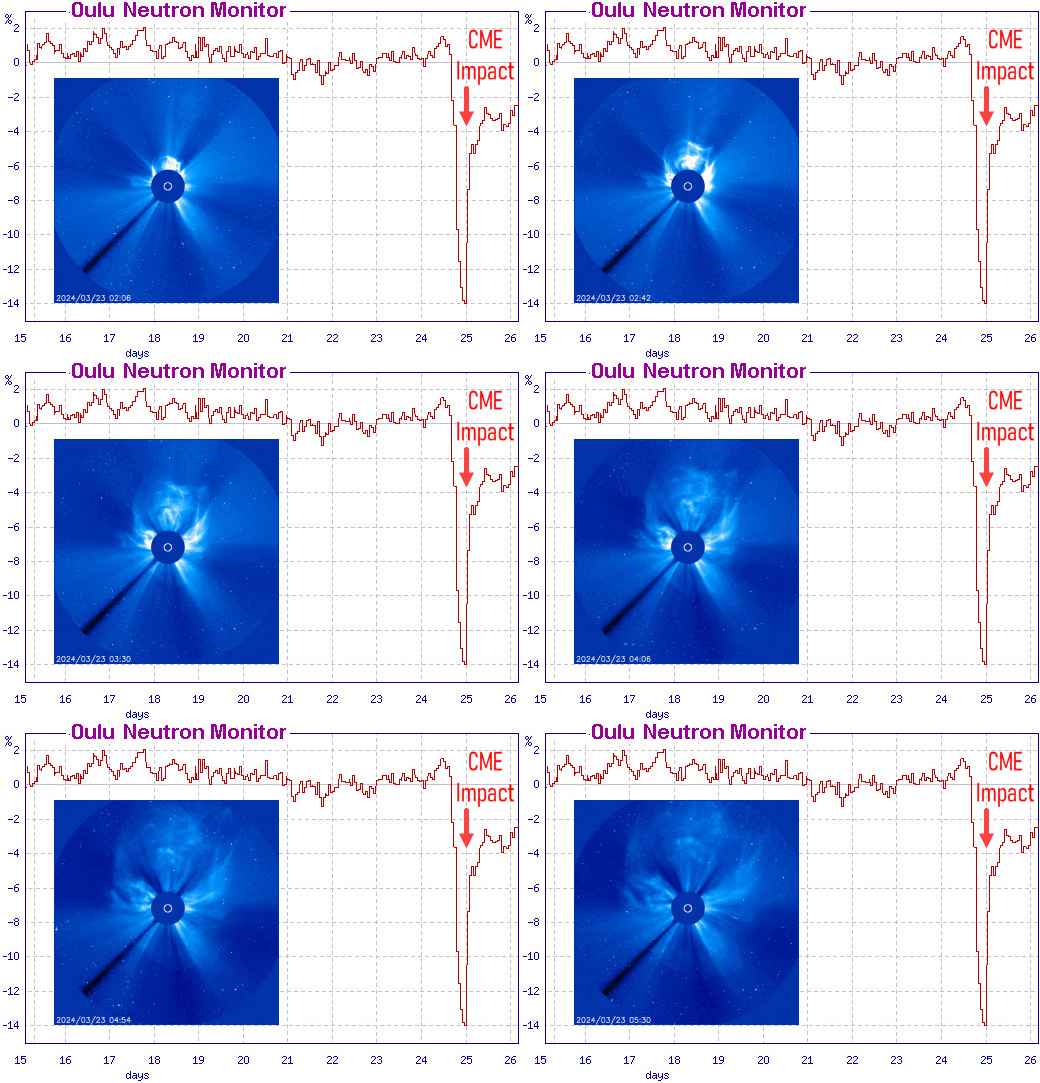
This is called a "Forbush decrease," named after American physicist Scott Forbush who studied cosmic rays in the early 20th century. It happens when a CME sweeps past Earth and pushes galactic cosmic rays away from our planet. Radiation from deep space that would normally pepper space stations and Earth’s upper atmosphere is briefly wiped out.
In the graph, above, the Forbush decrease is shown as a downward spike in neutron counts recorded at the Sodankyla Geophysical Observatory in Oulu, Finland. Neutrons are a well-known proxy for cosmic rays. When cosmic rays strike Earth's upper atmosphere, they produce a spray of neutrons that reach the ground below; sensors in Oulu count these particles to monitor activity in space.
This week's Forbush decrease is the biggest of Solar Cycle 25 (so far), exceeding the previous record-holder on Nov. 3-4, 2021 when a potent Cannibal CME dropped neutron counts by 11%.

Watch a real-time map of Starlink satellites orbiting Earth
In an effort to enhance the educational outreach of their Starlink constellation, SpaceX has an interactive global map of their Starlink internet satellites, which provides live coverage of every satellite in orbit around the Earth.
SpaceX started launching Starlink satellites in 2019, today, April 2, 2024, the number of active satellites in Earth orbit is an incredible 9531+, more than half being Starlinks.

99PanozAIV
Platinum Member
- Joined
- Mar 10, 2020
- Messages
- 16,726
- Reaction score
- 34,886
- Points
- 153

U.S. Navy Submarine First In World Fitted With Silent Caterpillar Drive - Naval News
Submarines use stealth to dominate the seas, presenting an illusive yet deadly threat. Now U.S. Navy submarines will take stealth to a new level. American submarines will now be fitted with magnetohydrodynamic drive.
 www.navalnews.com
Naval News Staff 01 Apr 2024U.S. Navy Submarine First In World Fitted With Silent Caterpillar Drive - Naval News
Submarines use stealth to dominate the seas, presenting an illusive yet deadly threat. Now U.S. Navy submarines will take stealth to a new level. American submarines will now be fitted with magnetohydrodynamic drive.
99PanozAIV
Platinum Member
- Joined
- Mar 10, 2020
- Messages
- 16,726
- Reaction score
- 34,886
- Points
- 153
Ha! They got me. Didn’t even look at the date.Naval News Staff 01 Apr 2024