

1 / 10

Vigilante Parts
2 / 10

Dynamic
3 / 10

Pacific
4 / 10

Madcap
5 / 10

Bigtime Automotive
6 / 10

DHR Motorsports
7 / 10

Probe
8 / 10

ATD
9 / 10

Jesel
10 / 10

Precision

You are using an out of date browser. It may not display this or other websites correctly.
You should upgrade or use an alternative browser.
Weird science stuff
- Thread starter 99PanozAIV
- Start date

AllRev
Gott mit uns

AllRev
Gott mit uns

AllRev
Gott mit uns

99PanozAIV
Platinum Member
- Joined
- Mar 10, 2020
- Messages
- 16,727
- Reaction score
- 34,887
- Points
- 153
Closer and closer…
”In a report on its progress, the lab said it achieved its highest yield in July when the reaction almost doubled the input, with the reaction releasing 3.88 megajoules of energy after the lasers delivered slightly over 2 megajoules. The lab says the reaction creates higher temperatures than those inside the sun, which, like other stars, is powered by fusion.”

 www.newser.com
”In a report on its progress, the lab said it achieved its highest yield in July when the reaction almost doubled the input, with the reaction releasing 3.88 megajoules of energy after the lasers delivered slightly over 2 megajoules. The lab says the reaction creates higher temperatures than those inside the sun, which, like other stars, is powered by fusion.”
'Holy Grail' of Clean Energy Was No Fluke
Lab says it's replicated fusion milestone at least 3 times
www.newser.com

Hollow65
Gold Member
- Joined
- Apr 14, 2021
- Messages
- 8,360
- Reaction score
- 25,063
- Points
- 153
Fucking ticks.

U.S. Man's Death Suggests Deadly Tick Virus Is Spreading to New Regions
A rare but sometimes fatal tickborne infection may be expanding its range in the U.S., local and federal health officials warn in a report this week. They say that a case of Heartland virus led to a man’s death in 2021. The infection is thought to have been caught in either Virginia or...news.yahoo.com
Mentions genetically modified ticks. Way to go government
Hollow65
Gold Member
- Joined
- Apr 14, 2021
- Messages
- 8,360
- Reaction score
- 25,063
- Points
- 153
Closer and closer…
”In a report on its progress, the lab said it achieved its highest yield in July when the reaction almost doubled the input, with the reaction releasing 3.88 megajoules of energy after the lasers delivered slightly over 2 megajoules. The lab says the reaction creates higher temperatures than those inside the sun, which, like other stars, is powered by fusion.”
'Holy Grail' of Clean Energy Was No Fluke
Lab says it's replicated fusion milestone at least 3 times
COSMIC SNOWBALLS DETECTED PELTING EARTH'S ATMOSPHERE
By Kathy Sawyer
May 29, 1997
Earth is bathed by a steady "cosmic rain" from previously undetected objects from outer space that pour vast quantities of water into the atmosphere, according to startling new evidence released today.
The objects, 20- to 40-ton snowballs the size of two-bedroom houses, streak into the atmosphere by the thousands each day, disintegrate harmlessly 600 to 15,000 miles up and deposit large clouds of water vapor that eventually fall on Earth's surface as rain, according to Louis A. Frank of the University of Iowa. He led the research team that for the first time has captured images of these objects.
The ramifications of the discovery are potentially enormous, Frank and other scientists said. If Frank's interpretation of the evidence is confirmed, it could force scientists to revise long-held beliefs about how Earth and the solar system evolved, how the building blocks of life first arose, how the oceans formed and whether fluxes in the cosmic rain could have caused the ice ages and mass extinctions of living species.
Scientists might also be compelled to study the impact of this alien precipitation on Earth's climate, the "greenhouse" effect and the "hole" in the ozone layer over Antarctica.
The discovery suggests that the volume of water on Earth is increasing. It also has implications for the evolution of other planets, such as Mars, that should be getting bathed in the same extraterrestrial drizzle.
"This relatively gentle cosmic rain -- which possibly contains organic compounds -- may well have nurtured the development of life on our planet," Frank said. He presented the unprecedented images, with graphs and analysis, to a riveted crowd of colleagues at a meeting of the American Geophysical Union here. "When it rains," he added, "look up and smile. You never know where it came from."
The evidence of snowballs from outer space comes from images taken at both ultraviolet and visible wavelengths by Frank's specially designed instrument aboard NASA's year-old POLAR spacecraft. One shows an object streaking across the sky and bursting over Europe last Sept. 26. Researchers noted that the snowballs disintegrate at altitudes well above the orbits of human occupants aboard U.S. shuttles and the Russian space station.

Mike Swann
Q̇=ṁCpΔT

In Search of a Bigger Boom
What drove Edward Teller to push for a 10,000 megaton hydrogen bomb?
 blog.nuclearsecrecy.com
99PanozAIV
Platinum Member
- Joined
- Mar 10, 2020
- Messages
- 16,727
- Reaction score
- 34,887
- Points
- 153
“since that particular design would probably kill everyone on Earth, there was no use carting it anywhere.”In Search of a Bigger Boom
What drove Edward Teller to push for a 10,000 megaton hydrogen bomb?


99PanozAIV
Platinum Member
- Joined
- Mar 10, 2020
- Messages
- 16,727
- Reaction score
- 34,887
- Points
- 153
Interesting. I probably won’t live to see it but this is what will launch manufacturing in space. If you can avoid having to lift the stuff off planet, it makes sense to just manufacture the shit right where you might need it. I’m going to miss seeing a lot of interesting shit.Home
edit post News Trump to downsize U.S. military presence in Germany by Washington Post May 1, 2026 Optimal Column Thisdnyuz.com
Mike Swann
Q̇=ṁCpΔT
1958, just amazing

 getpocket.com
The Most Important Computer You’ve Never Heard Of
How SAGE jumpstarted today’s technology and built IBM into a powerhouse.

AllRev
Gott mit uns
Saving video for viewing later. Interesting comments.

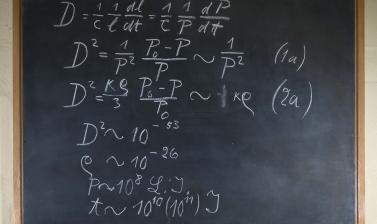
Blackboard used by Albert Einstein
This blackboard was preserved from Einstein’s second lecture in Oxford, on 16 May 1931, and its equations connect the age, density and size of the universe.
 www.hsm.ox.ac.uk
One of y'all slide rule users post up the cliff notes please.

Last edited:
AllRev
Gott mit uns
"Cliff's not here man!"Blackboard used by Albert Einstein
This blackboard was preserved from Einstein’s second lecture in Oxford, on 16 May 1931, and its equations connect the age, density and size of the universe.
One of y'all slide rule users post up the cliff notes please.

99PanozAIV
Platinum Member
- Joined
- Mar 10, 2020
- Messages
- 16,727
- Reaction score
- 34,887
- Points
- 153
OK, this is a weird one. I realize inflammatory responses are responsible for a lot of symptoms of infections but ALL of them? It’ll be interesting to see where this leads if confirmed.
”When mice lacking key adaptive immune cells were infected with SARS-CoV-2 virus, even though they are not able to clear the virus, they developed no symptoms, revealing that the body's own inflammatory immune response to fight the infection was causing the pathology, according to a new study.”

 medicalxpress.com
”When mice lacking key adaptive immune cells were infected with SARS-CoV-2 virus, even though they are not able to clear the virus, they developed no symptoms, revealing that the body's own inflammatory immune response to fight the infection was causing the pathology, according to a new study.”
Research reveals mice without immune cells show no SARS-CoV-2 symptoms
When mice lacking key adaptive immune cells were infected with SARS-CoV-2 virus, even though they are not able to clear the virus, they developed no symptoms, revealing that the body's own inflammatory immune response to fight the infection was causing the pathology, according to a new study.