Engine Pictures

Plug wires are not in the plastic holder at the rear of the valve cover in the correct order. Should be 5-1-3-7, so 5 & 7 are not near each other.

You’s a picky mfkr ain’t ya’ … 🤣🤣🤣🤣

Good eye.. 😁👍
 
470217968_122160449162280396_7721621059631017519_n.jpg
 
John Kaase made stupid power with his "Y" block one year at Engine Masters, he did not just win, he dominated!

He changed and re-arranged so many things on it that it was prolly his toughest build.
+1 That one was WAY out of the box. He extended the ports and combustion chambers down past the head gaskets. I believe they changed the rules because of him.
 
That was a "425HP 396" and would be mechanical cam and the '65 Chevelle right there is the OE application of the R-3310 780cfm Holley.

Plug wires are not in the plastic holder at the rear of the valve cover in the correct order. Should be 5-1-3-7, so 5 & 7 are not near each other.
Actually, upon further pondering, the plastic wire clip is the one for the right side. The left side clip has a long space between 1-3-5 ---- 7. Or, 5-1-3 ---- 7 ??
 
Last edited:
I remember it clearly as a "Y" block.
All the Ford engines designed in the '50s were Y configuration with the pan rail below the crank centerline, as with the cross-bolted 427. The nickname "Y-Block" usually denotes the 239-256-272-292-312 series, although all the Ford OHV V-8s in the '50s have the block skirt extending below the crank center.

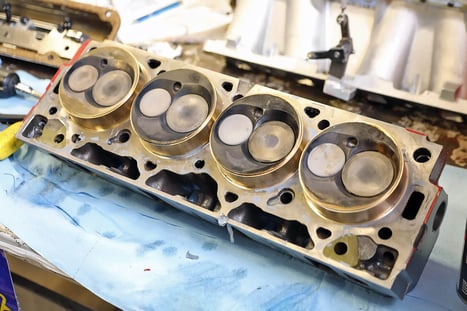
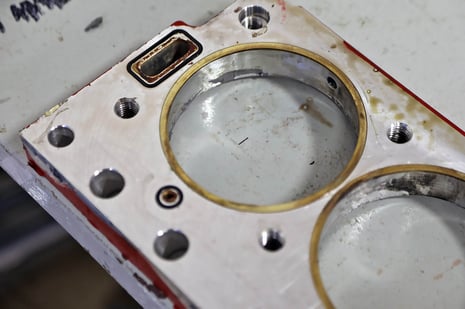
The Kaase engine with the brass combustion chamber inserts down into the cylinder is the MEL

006-engine-masters-2017-jon-kaase-MEL.jpg

005-engine-masters-2017-jon-kaase-MEL.jpg


That was a "425HP 396" and would be mechanical cam and the '65 Chevelle right there is the OE application of the R-3310 780cfm Holley.

Plug wires are not in the plastic holder at the rear of the valve cover in the correct order. Should be 5-1-3-7, so 5 & 7 are not near each other.
Z-16
It was a little weird for it's time. Putting in a hydraulic cam was strange, perhaps they wanted the buyer to have an easier time as an owner then the same person with a 396/425HP 1965 Vette of the same year with the solid. Personally I loved the 396 as a young man as I could afford it over the 427 when I was engine swapping. I installed many a 396/375 solid in my 396/325HP engines and they were great! They sounded wicked and as long as you didn't step on it leaving the drive-in no one had a clue to what you were running!

I learned the hard way to replace the hydraulic rocker arms for ones from Chevrolet that were numbered and made for the solid, the solid cam would eventually pound the hydraulic rockers and hole them.


Last edited:
All the Ford engines designed in the '50s were Y configuration with the pan rail below the crank centerline, as with the cross-bolted 427. The nickname "Y-Block" usually denotes the 239-256-272-292-312 series, although all the Ford OHV V-8s in the '50s have the block skirt extending below the crank center.

The Kaase engine with the brass combustion chamber inserts down into the cylinder is the MEL

006-engine-masters-2017-jon-kaase-MEL.jpg

005-engine-masters-2017-jon-kaase-MEL.jpg


Thanks, that is the engine that I was remembering and stand corrected. I am sure you know but many do not that the combustion chamber was on the piston side, not the head, like the 348/409. Very inefficient by todays standards and also very dirty by pollution standards.

I work on a friends 1966 Lincoln vert and really hate it, heavy and really a pig. Hard to believe there was at least one Top Fuel team running a M.E.L. when the 392 was available for two years in a similar time frame of racing.

That is why the 1969 Lincoln is the one to have and actually quite rare and expensive when they come up for sale, it was the first year for the 460 and the special C6 transmission bell to fit the Lincoln flat floor, after 1969 that uni-body was gone for a newer platform.
See post 1048 Kaase built both

2015 and 2017 events. Y block was 584hp and MEL was 698hp. That man get's it done.
 
See post 1048 Kaase built both

2015 and 2017 events. Y block was 584hp and MEL was 698hp. That man get's it done.
Yes, but I was remembering the M.E.L. build that I thought was the "Y" block in my head, should have checked.

In the aircraft simulator when we would make a mistake we called it a "Senior Moment", that was one of those, I am 71 and showing it.
 
Hear Maria Tomei's voice in My Cousin Vinny, "No! The Defense is Wrong!" Those two magazine blurbs are full of shit. They (and I guess you) are morphing the hydraulic lifters and HP ratings from later years into a 1965 past they never lived. A 325HP 396 was available in Impala but not Chevelle, only 283, 327, and 425HP 396 in Chevelle in 1965.

The first of the '65 396 425HP mechanical cam engines had bunkum valve spring retainers that the center would break out of the spring flange and drop the valve when valve float was involved, so warranty ate many of them. The ones I saw that failed, it was hard to understand how an engineer would make a retainer with such a weak spot, must have never played with flexing a coffee can bottom in and out, poik~poik~poik~

The '65 425HP 396 Chevelle I adjusted the valves on definitely had a mechanical cam, .020" I & .024" E. There was only a 325HP and 425HP (rated) 396 in 1965, in all Chevys, Impala, Chevelle and Corvette.

In 1966 the identical large port, 4 bolt main, aluminum intake, 396 engine was rated 375HP in the Chevelle. The Corvette and Impala got a 427 425HP, mechanical cam, and a 427 390HP hydraulic version was available, 4-door Biscayne state cop cars got those. 325HP and 360HP hydraulic lifter 396 engines were available in the Chevelle, as was the 375HP mechanical lifter.

The '65 Z-16 425HP 396 most definitely has solid lifters.

The magazine people are libtards and would re-write and misquote The Constitution to say what ever fantasy they have at the moment. I swear, I think there is a conspiracy to destroy carburetors with misinformation and junk articles full of totally wrong "advice".
 
Ed Pink is known for many good things that he has accomplished in his life, the two I know most about was how to tune a SHOC in spite of the timing chain stretch and another important one he and an employee solved the Bosch computer that regulated the RPM of the Porche 917! He was doing a lot of those engines for customers and was locked out of any mods for years until he solved that puzzle and then all of his 917 engines were the best out there and even sounded different as they would really RPM where the others were limited by that box!
 
Back
Top